

You’re staring at a chemistry problem set that’s due tomorrow morning. You know AI could help you solve it in seconds, but a nagging question sits in the back of your mind: If I use AI, is that plagiarism?
You’re not alone. Millions of students in 2026 face this exact tension every single day. AI tools are everywhere, professors are updating their academic integrity policies in real time, and the line between “getting help” and “copying answers” feels blurry at best. The anxiety is real — you want to succeed, but you also want to actually learn the material and keep your academic record clean.
Here’s the good news: there is absolutely a way to use AI to help with homework without plagiarizing. The key isn’t avoiding AI altogether — it’s using it the right way. Tools like Scrny are specifically designed to help students understand their coursework through guided explanations, not just hand over copy-paste answers. In this guide, we’ll break down exactly what counts as plagiarism when using AI, how to leverage artificial intelligence ethically, and how to turn AI into your most powerful study partner — without ever crossing the line.
What Does “Plagiarism” Actually Mean When It Comes to AI?
Before you can use AI responsibly, you need to understand what plagiarism looks like in the context of homework and artificial intelligence. Traditionally, plagiarism means presenting someone else’s words, ideas, or work as your own. With AI in the picture, institutions have expanded that definition.
Most universities and high schools in 2026 define AI-related plagiarism as:
- Submitting AI-generated text or solutions as your own original work without disclosure
- Copying AI outputs word-for-word into essays, lab reports, or problem sets
- Using AI to complete assignments in ways that bypass the learning objectives the assignment was designed to achieve
- Failing to cite or acknowledge AI assistance when your school’s policy requires it
Notice what’s not on that list: using AI to learn. There’s a massive difference between asking an AI to write your essay for you and asking an AI to explain a concept you don’t understand so you can write a better essay yourself. The first is academic dishonesty. The second is studying.
The Gray Area Most Students Get Wrong
The trickiest situation is when students use AI to generate a solution, then rephrase it slightly and submit it. Many students believe that paraphrasing AI output makes it “theirs.” Most academic integrity boards disagree. If the ideas, structure, and reasoning came from AI and you simply swapped out a few words, that’s still presenting AI-generated work as your own.
The ethical approach isn’t about disguising AI’s involvement — it’s about using AI as a teaching tool that helps you produce genuinely original work rooted in your own understanding.
How AI Can Help You Learn Without Crossing Ethical Lines
So how do you actually use AI to help with homework without plagiarizing? The answer comes down to how you interact with the tool. Think of AI less like a ghostwriter and more like a tutor sitting next to you at a desk.
Here’s a framework for ethical AI use:
1. Use AI to Understand, Not to Submit
The most important rule is simple: never submit AI-generated content as your finished work. Instead, use AI to break down concepts you’re struggling with. Once you understand the material, close the AI tool and complete the assignment in your own words, using your own reasoning.
For example, if you’re stuck on a calculus integration problem, you could screenshot the question and have an AI explain the technique involved — what integration by parts is, when to use it, and why it applies here. Then you work through the problem yourself, using that understanding.
2. Ask for Explanations, Not Just Answers
There’s a world of difference between “Give me the answer to question 5” and “Can you explain the concept behind question 5 so I can solve it myself?” The second approach is what makes AI a legitimate learning aid rather than a plagiarism risk.
This is exactly the philosophy behind Scrny’s Learn Mode, which uses Socratic questioning to guide students through problems step by step instead of simply revealing the final answer. You’re prompted to think, reason, and arrive at the solution through your own cognitive effort — the AI just helps light the path.
3. Use AI to Check Your Work, Not Create It
One of the most ethically sound ways to use AI for homework is as a verification tool. Complete your assignment first using your own knowledge, then use AI to review your reasoning. Did you make an algebraic error in step three? Did you misidentify the type of chemical reaction? AI can catch those mistakes and explain why they’re wrong, helping you learn from your errors.
4. Cite AI When Required
More and more schools now have explicit policies on AI disclosure. If your institution requires you to acknowledge AI assistance, do so — even if you only used it for concept explanations. Transparency is always the safest approach, and it shows your professor that you’re using AI as a supplement to your learning, not a replacement for it.
Real-World Examples: Ethical vs. Unethical AI Use
Let’s make this concrete with a few scenarios students commonly encounter:
Scenario 1: Essay Writing
- ❌ Unethical: Pasting your essay prompt into an AI and submitting the generated essay, even with light edits.
- ✅ Ethical: Using AI to brainstorm thesis ideas, asking it to explain a historical event you’ll reference, then writing the entire essay yourself in your own voice.
Scenario 2: Math Problem Set
- ❌ Unethical: Screenshotting every problem, copying the AI’s solutions, and turning them in.
- ✅ Ethical: Attempting every problem first, then screenshotting the ones you got stuck on and asking the AI to explain the approach — not just the answer. Reworking those problems yourself afterward.
Scenario 3: Science Lab Report
- ❌ Unethical: Having AI generate your analysis and conclusion sections.
- ✅ Ethical: Using AI to clarify what a certain statistical test measures so you can correctly interpret your own data and write the analysis yourself.
Scenario 4: Multiple Choice Review
- ❌ Unethical: Using AI during a proctored exam to look up answers in real time.
- ✅ Ethical: While studying before the exam, screenshotting practice questions and using AI to explain why each correct answer is correct and why the distractors are wrong.
In every case, the ethical path puts your understanding at the center of the process.
Why Scrny Is Built for Learning, Not Plagiarism
Not all AI homework tools are created equal. Some are designed to generate polished, submission-ready answers. Scrny takes a fundamentally different approach — it’s built to be an AI homework helper that prioritizes genuine comprehension.
Here’s how Scrny supports ethical, plagiarism-free studying:
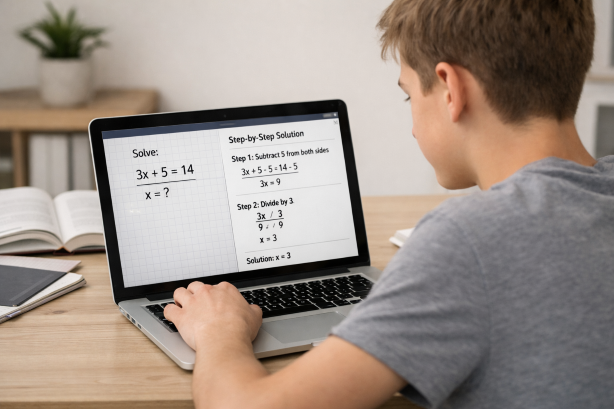
- Screenshot-Based Input: Simply screenshot any homework question — whether it’s a math equation, a science diagram, a coding challenge, or a multiple-choice problem — and Scrny’s AI analyzes it instantly. This works for handwritten problems, textbook pages, PDFs, and online assignments alike.
- Learn Mode (Socratic Method): This is Scrny’s standout feature for students who want to use AI without plagiarizing. Instead of showing you the answer immediately, Learn Mode asks guiding questions that walk you through the reasoning process. It’s like having a patient tutor who helps you figure things out on your own. The knowledge sticks because you did the thinking.
- Answer Mode with Full Explanations: When you do need to see a complete solution — for checking your work or understanding a worked example — Scrny’s Answer Mode doesn’t just give you a final number or statement. It provides detailed, step-by-step breakdowns so you understand how and why the solution works.
- Desktop and Mobile App: Scrny runs on Windows, macOS, and mobile devices, making it a seamless part of your study workflow whether you’re at your desk or reviewing notes on the go.
- Covers All Major Subjects: Math, physics, chemistry, biology, computer science, history, English — Scrny handles the full range of academic subjects students encounter from middle school through college.
The entire design philosophy is centered on helping you learn the material so you can produce your own original work with confidence. That’s the difference between a tool that enables plagiarism and one that prevents it.
Tips for Using AI Ethically in Your Homework Routine
Want a practical playbook for using AI to help with homework without plagiarizing? Here are strategies that keep you on the right side of academic integrity:
- Always attempt the problem first. Even if you only get partway through, starting on your own activates your thinking and gives you context for understanding the AI’s explanation.
- Set a “no copy-paste” rule for yourself. If you never copy AI text directly into an assignment, you dramatically reduce your plagiarism risk. Force yourself to close the AI tool and write in your own words.
- Use Learn Mode before Answer Mode. If your AI tool offers guided learning (like Scrny does), start there. Only look at complete solutions after you’ve genuinely wrestled with the problem.
- Keep a learning log. Jot down what concepts the AI helped you understand. This reinforces your memory and gives you documentation that you used AI for learning, not for generating submissions.
- Read your school’s AI policy. Policies vary widely in 2026. Some professors encourage AI use with disclosure; others prohibit it entirely on certain assignments. Know the rules before you start.
- Ask your professor when in doubt. If you’re unsure whether a particular use of AI is acceptable, ask. Most educators appreciate students who proactively seek clarity — it shows integrity.
- Focus on the process, not just the product. Homework exists to help you learn. If you use AI in a way that helps you understand the process of solving a problem, you’re using it correctly — even if it takes longer than just copying an answer.
Frequently Asked Questions
Is using AI for homework considered plagiarism?
It depends entirely on how you use it. Using AI to generate and submit work as your own is considered plagiarism or academic dishonesty at most institutions. However, using AI as a study and learning tool — to understand concepts, check your reasoning, or get explanations — is generally considered ethical and acceptable, similar to using a tutor or textbook.
Can teachers detect if I used AI on my homework?
Yes, many educators in 2026 use AI detection tools, and experienced teachers can often recognize AI-generated writing by its patterns, tone, and structure. More importantly, if you don’t actually understand the material you submitted, it becomes obvious during exams or class discussions. The safest and most effective approach is to use AI for learning and produce your own original work.
What’s the best AI to help with homework without plagiarizing?
Look for tools specifically designed for learning rather than content generation. Scrny is built with this philosophy — its Learn Mode uses Socratic questioning to guide you toward understanding instead of just handing over answers. The screenshot-based input lets you get help on any specific problem, and the detailed explanations ensure you know why the solution works so you can replicate the reasoning yourself.
How do I cite AI if my school requires it?
Citation practices for AI vary by institution and style guide. Generally, you should note the tool used (e.g., “Scrny AI homework helper”), the date you accessed it, and a brief description of how you used it (e.g., “Used to understand the concept of electronegativity before writing my own analysis”). Check your school’s specific guidelines or ask your professor for their preferred format.
Using AI to help with homework without plagiarizing isn’t complicated — it just requires the right mindset and the right tool. The students who thrive in 2026 aren’t the ones who avoid AI entirely, and they’re not the ones who use it to bypass learning. They’re the ones who harness AI as a study partner that deepens their understanding and makes them more capable, not more dependent.
Scrny was built for exactly this kind of student. With Learn Mode’s guided approach, detailed step-by-step explanations, and screenshot-based convenience, it’s the AI homework helper that keeps you learning honestly and effectively. If you’re ready to study smarter while keeping your integrity fully intact, visit Scrny.ai and see how AI-powered homework help is supposed to work.
Turn a Screenshot Into an AI Answer in 3 Seconds.
Snip an image and let our AI answer generator do the rest.
Save time: no copy-pasting questions.
Stay accurate: 99 % accuracy using the latest AI answer generator technology
Monthly Subscription. Cancel anytime.
Recommended Articles

[
AI Homework Helper: Screenshot Any Question, Get Instant Answers
](https://scrny.ai/)
By Scrny.ai
[
How to Use Screenshot Homework Help: Snap a Photo, Get Step-by-Step Solutions
](https://scrny.ai/blog/screenshot-homework-help)
By Scrny.ai

[
Best AI Homework Helper 2026: Top Tools Compared
](https://scrny.ai/blog/best-ai-homework-helper)
By Scrny.ai