

Every list like this has the same problem: it's written by one of the companies on it. So let's get the disclosure out of the way first — we build Scrny, it's on this list, and we've tried to be more useful than flattering. Scrny loses several of the categories below, and we say so, because a comparison you can't trust is worth nothing.
Here's the short version: there is no single best AI homework helper. There's a best one for the kind of homework you actually have — and the eight tools below split the map between them.
How we judged
Five things separate tools you'll still be using in December from tools you delete in a week:
- Input method. Can you screenshot or photograph the question, or must you retype it? For math notation, diagrams, and 40-question problem sets, this decides everything.
- Reasoning, not just answers. A bare answer is worthless on the next problem. Does the tool show working you can follow?
- Coverage. Math-only? Text-only? Or the whole spread of a real course load?
- Accuracy — and honesty about it. Every AI tool gets things wrong. The good ones make wrong answers easy to catch by exposing their steps.
- What it really costs. "Free" tools pay for themselves somehow: ads, caps, upsells, or your data.
The eight tools
ChatGPT — the general-purpose baseline
The tool everything else gets compared to. Best-in-class at explaining concepts in plain language, brainstorming essay structure, and answering the follow-up question no purpose-built tool anticipates. The free tier is genuinely useful.
Where it falls down for homework specifically: workflow. Pasting one algebra problem works; working through a screenshotted 20-question set doesn't. And because it answers everything with equal confidence, a wrong answer looks exactly like a right one. We wrote up the full comparison at Scrny vs ChatGPT.
Verdict: best for essays, concept explanations, and open-ended "help me understand this" conversations.
Photomath — the camera math specialist
Point your phone camera at a printed or handwritten equation and it returns clean, step-by-step solutions. For textbook algebra and calculus, it's excellent — arguably the most polished single-subject tool on this list, and its handwriting recognition is strong.
The boundary is the subject line: it's math only, and it's strongest on equations rather than wordy applied problems. If your homework is on a screen rather than paper, the camera workflow adds friction. Full head-to-head: Scrny vs Photomath.
Verdict: best for photographing equations out of a physical textbook.
Khanmigo — the tutor that won't just tell you
Khan Academy's AI tutor deliberately refuses to hand over answers — it asks guiding questions until you get there yourself, layered on top of the best free lesson library on the internet. If your goal is genuinely learning the material with no shortcuts available, this is the most principled option, and Khan Academy's core content remains free.
The flip side: when it's 11pm and you need to check twenty finished answers rather than re-derive them Socratically, the pace hurts. More at Scrny vs Khan Academy.
Verdict: best for structured learning when time isn't the constraint.
Chegg — the textbook answer library
Chegg's core value predates the AI wave: an enormous database of worked solutions to actual textbook problems, written by humans, searchable by book and problem number. For college courses that assign problem sets straight from a standard textbook, that specificity is hard to beat.
It's a subscription, the AI features are additions to the database rather than the main event, and for anything not in the library you're better served elsewhere.
Verdict: best for college textbook problem sets.
Quizlet — the memorization engine
Flashcards, practice tests, and spaced repetition, with AI features layered on. Quizlet isn't really an answer tool — it's a retention tool, and for vocab, dates, definitions, and anatomy it's the right shape entirely. Comparison: Scrny vs Quizlet.
Verdict: best for memorization-heavy subjects and test prep drilling.
Brainly — the community fallback
Community Q&A: post a question, other students and volunteers answer. Sometimes you get a great explanation; sometimes you get something confidently wrong, and telling the difference is on you. It's free-ish, with the usual ad and upsell pressure.
Verdict: best as a free fallback when a question stumps the automated tools.
AnswersAI — the generic AI answer engine
Paste a question, get an AI answer, across a wide subject spread. It's a capable text-first generalist with real traction. The difference in philosophy is input and explanation depth — it's built around typed questions where Scrny is built around screenshots. We compare them directly at Scrny vs AnswersAI.
Verdict: best for quick typed questions across many subjects.
Scrny — the screenshot specialist (ours)
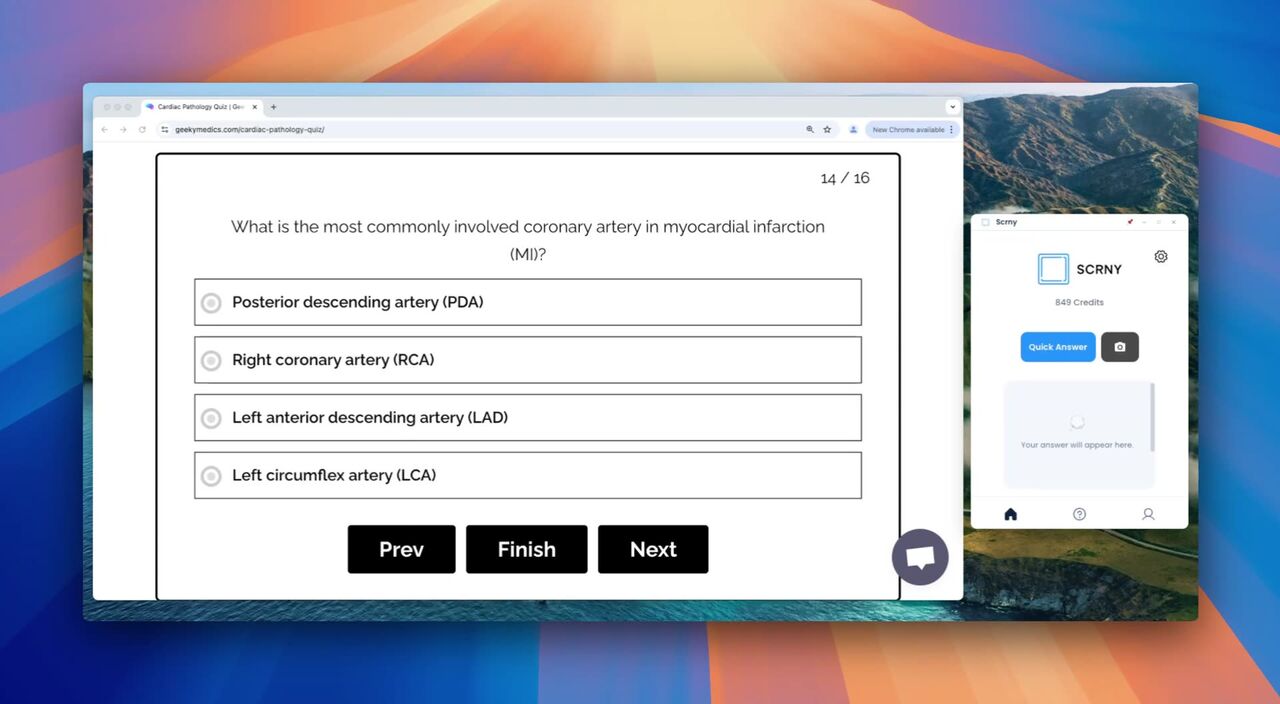
Scrny does one thing structurally differently: you screenshot the question — typed, handwritten, diagram, code error, anything on your screen — and it answers with the reasoning shown, in about 2.4 seconds on average. Four modes cover the format spread: Multiple Choice (explains why every option is right or wrong — 99% accuracy on standard practice-exam questions across the AZ-900, AWS Cloud Practitioner, CompTIA A+/Network+/Security+ and CCNA prep banks), Math Solver (step-by-step with verification), Learn Mode (guided Socratic route when you want to be walked there, not carried), and Tech Support (reads error messages and stack traces).
Where Scrny is not the pick, so you don't have to guess: essay writing (use ChatGPT), photographing paper textbooks (Photomath's camera flow is smoother), memorization drilling (Quizlet), and there's no free tier — plans are $1.99/month for 15 answers, $5.99 for 200, or $7.99 for 500, cancel anytime. We charge from the first answer because each one is a real vision-model call; the $1.99 plan exists to keep trying it nearly free.
Verdict: best for on-screen homework — multiple-choice sets, screenshots, practice exams — where you want the why, fast.
Side by side
| Tool | Input | Shows reasoning? | Coverage | Pricing model |
|---|---|---|---|---|
| ChatGPT | Type/paste | Yes, conversational | Everything | Free tier + subscription |
| Photomath | Phone camera | Yes, step-by-step | Math only | Free + paid tier |
| Khanmigo | Chat | Guides, won't just answer | Khan curriculum | Subscription (lessons free) |
| Chegg | Search by textbook | Human-written solutions | Textbook sets | Subscription |
| Quizlet | Flashcards/sets | N/A (retention tool) | Memorization | Free tier + subscription |
| Brainly | Post a question | Varies by answerer | Community-wide | Free with ads/upsells |
| AnswersAI | Type/paste | Yes | Broad | Subscription |
| Scrny | Screenshot | Yes, every option/step | MCQ, math, code, general | From $1.99/mo, no free tier |
Pick by situation
- Practice exams and MCQ sets on a screen → Scrny
- Equations in a paper textbook → Photomath
- Essays and "explain this concept" → ChatGPT
- Learning with no shortcuts → Khanmigo
- Standard college textbook problems → Chegg
- Vocab and memorization → Quizlet
- Zero budget → ChatGPT free tier + Khan Academy, Brainly as backup
Test before you trust
Whatever you pick, run the same five-minute audit: take three questions you already have verified answers for — one easy, one hard, one with an image or diagram — and feed them in. You learn more about a tool from one question it gets wrong (does the shown reasoning make the error findable?) than from ten it gets right. We wrote a fuller version of this checklist in our homework scanner buyer's guide.
The honest limits
All of these tools — ours included — share two failure modes you should know about. First, they're worse at knowing that they're wrong than at being right: confident tone is not evidence. That's why "shows reasoning" was a scoring criterion; visible steps are your audit trail. Second, they make it easy to mistake having the answer for having the skill. The difference shows up on exam day, when the tool isn't there. Use them to close the gap between "stuck" and "understood" — checking finished work, decoding wrong answers on practice tests, getting unstuck at step three of five (our guide to studying with AI math help goes deeper on that workflow).
And none of them belong in a graded, closed-book exam. That's not what any of this is for.