

Here's the uncomfortable truth about multiple choice homework: getting the right answer teaches you almost nothing. The question was written backwards — the test author started from the ways students misunderstand the topic and built the wrong options out of them. Which means the wrong answers are where the course material actually lives. Study those, and one question teaches you four things.
That inversion is the whole method below. Technique first — it works with or without any tool — then where an AI helper genuinely earns its place in the loop.
Read the stem the way the author wrote it
Before looking at a single option, read the stem twice and extract three things:
- The qualifier. Always, never, most, least, except, best — one word that flips which options survive. "Which is not a property of…" eliminates readers who skim, by design.
- The actual task. "Best explains", "first step", "most likely cause" are different questions built on the same facts.
- The scope. A question about eukaryotic cells has already ruled out answers that are true only of bacteria.
Misreading the stem is the single most common source of wrong answers on material you actually know — and it's the one failure no amount of content review fixes.
Eliminate in order of confidence, not option order
Weak test-takers read options A→D and argue with each one. Strong ones make three passes:
- Kill the impossible. Anything factually wrong or out of scope goes first — usually one or two options.
- Kill the true-but-irrelevant. The classic trap: a statement that is completely correct and does not answer the question that was asked.
- Compare what's left. Now — and only now — weigh the two survivors against the stem's exact wording. "Best answer" questions are decided here, on precision, not on truth.
This order matters because it spends your certainty first and your judgment last, which is also how you should budget your time: seconds on passes one and two, the bulk of your thinking on pass three.
Budget time like the scoring is per-question — because it is
Every MCQ is worth the same whether it takes you twenty seconds or four minutes, so time is the resource distractors are really attacking. Three rules keep the budget honest:
- Set a per-question ceiling before you start — total time divided by question count, minus a review buffer. When you hit it, mark the question, commit to your best surviving option, and move.
- Never leave a question blank on the first pass. A marked guess plus a return visit beats an empty answer you never get back to.
- Protect the easy points first. The questions you can answer in twenty seconds fund the four-minute wrestling matches — collect them all before spending big anywhere.
On homework the clock is softer, but practising the ceiling is the point: the habit has to exist before the exam does. Reserve the deep, unhurried analysis for the review loop afterwards, where it actually builds knowledge.
Learn the five distractor patterns
Wrong options aren't random; they're manufactured from predictable molds. Once you can name them, you see them:
| Pattern | What it looks like | What it's testing |
|---|---|---|
| Partial knowledge | Right if you know half the concept | Depth |
| Calculation echo | The answer you get from one common slip | Care |
| Reversed logic | True with the relationship flipped | Reading |
| Close-but-off | Correct except one word or unit | Precision |
| Keyword bait | Vocabulary from the chapter, wrong claim | Recognition vs. understanding |
When you review homework, don't just log right/wrong — log which pattern caught you. Three "calculation echo" misses in a week is a more useful diagnosis than any percentage score.
A worked example
Cellular respiration: (A) occurs only in plant cells, (B) produces carbon dioxide as a byproduct, (C) requires light energy, (D) takes place in the nucleus.
B is correct. But the wrong options are the lesson: A is a scope trap (all eukaryotic cells respire), C is a reversed-logic trap (that's photosynthesis — the paired concept you're expected to confuse), and D is keyword bait (organelle vocabulary, wrong organelle — it's the mitochondria). One question, four facts, and a map of exactly how this topic gets confused. That map is what you're actually being tested on next week.
Where the AI helper fits
Everything above works with a pencil. Here's what changes with a tool like Scrny's multiple choice mode: the explanation stops being something you generate alone and becomes something you check yourself against.
The workflow is a screenshot — stem, every option, any diagram — and the answer comes back in about 2.4 seconds. The part that matters for studying is the Explain button: Scrny doesn't just name the letter, it walks through why the correct option wins and why each wrong option is wrong — which is precisely the distractor analysis from the sections above, done for every question you feed it. It reads the question as an image, so code snippets, topology diagrams, and chemistry structures are handled rather than skipped, and it's tested at 99% accuracy on standard practice-exam questions across the AZ-900, AWS Cloud Practitioner, CompTIA, and CCNA banks.
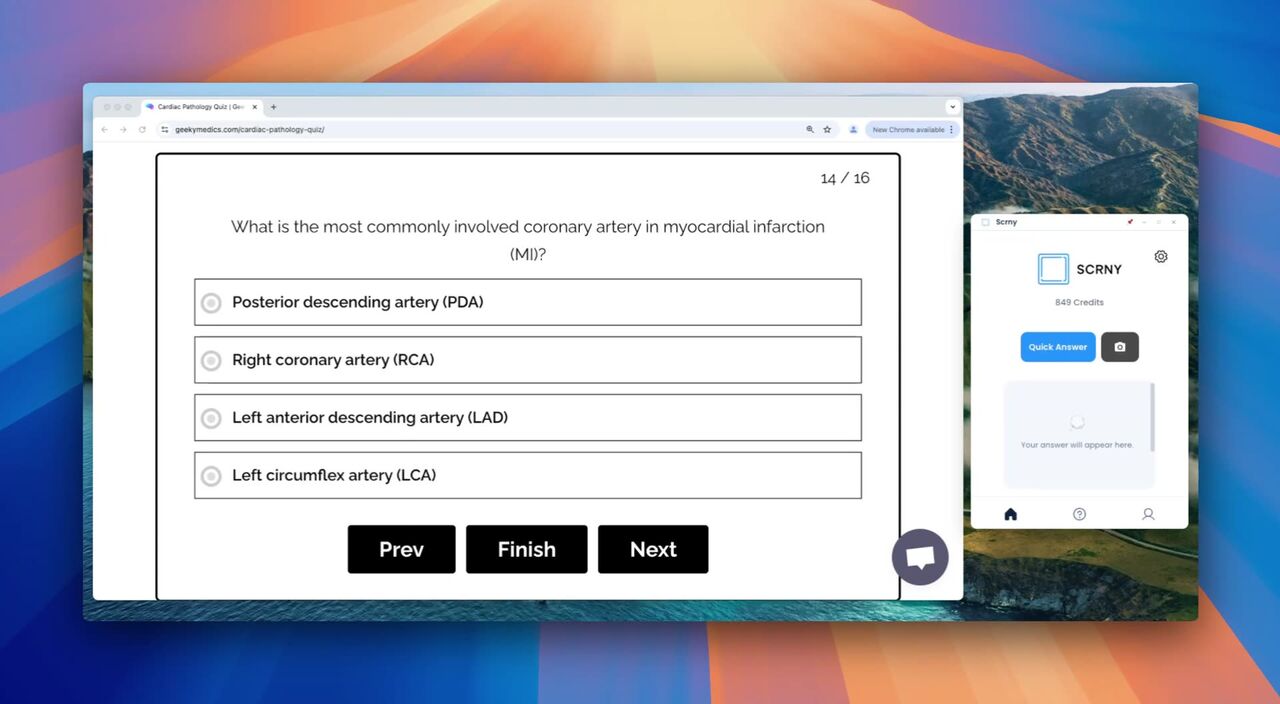
Two honest caveats. First, 99% is not 100% — the explanation is your audit trail, and if the reasoning doesn't survive your reading, trust your reading. Second, this is a practice-and-study tool: homework, practice banks, revision. Using it inside a graded or proctored exam is academic dishonesty, and no study strategy is worth that trade.
The study loop that compounds
Where students plateau is treating each question as an event. The loop that compounds instead:
- Attempt first, always. Commit to an answer before any help — even a guess. A checked guess produces learning; a skipped attempt produces dependence.
- Explain every question, not just misses. A right answer you can't defend was a guess wearing a uniform. Run the explanation anyway; Scrny's per-option breakdown makes this a thirty-second habit.
- Name the pattern on every miss. Distractor table, above.
- Re-derive it cold. Close the explanation and reconstruct the reasoning yourself — out loud is better. If you want the tool to hold you to this, Learn Mode inverts the flow and guides you with questions instead of handing you the answer.
- Return in three days. Re-attempt the misses. This is the spacing effect, and it's the cheapest grade improvement in existence.
For practice-test season, the same loop scales up: full test, then explanations across the board, then a pattern tally, then a spaced re-attempt of the miss list. Question banks recycle concepts, not questions — understanding why option C was a scope trap transfers; memorising "the answer was B" does not. If most of your MCQ work happens in online course platforms and PDFs, the screenshot workflow covers those directly — see the six-screenshot test for how to evaluate any capture-based helper, or the wider field guide if you're comparing tools.
Multiple choice rewards exactly one thing reliably: understanding the question the way its author built it. Strategy gets you there; a helper that explains every option gets you there faster. The order of those two is the entire trick.