
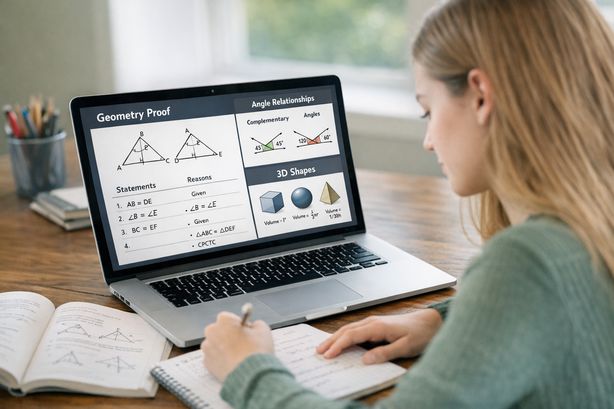
Geometry is one of those subjects that can feel like an entirely different language. One night you’re breezing through algebra equations, and the next you’re staring at a diagram full of parallel lines, transversals, and angle bisectors wondering where to even begin. If you’ve ever spent an hour on a single proof or second-guessed whether two triangles are congruent by ASA or AAS, you’re far from alone. The need for reliable geometry homework help is one of the most common academic struggles students face from middle school through college.
The challenge with geometry isn’t just the math—it’s the visual-spatial reasoning, the logical structure of proofs, and the sheer number of theorems you’re expected to memorize and apply simultaneously. Unlike arithmetic or basic algebra, geometry demands that you see relationships between shapes, construct logical arguments, and often work backward from what you need to prove. It’s a subject where staring at the textbook longer doesn’t always lead to a breakthrough.
That’s exactly why tools like Scrny exist. Scrny is an AI-powered desktop application that lets you screenshot any geometry problem—whether it’s a diagram-heavy proof, a coordinate geometry question, or a tricky angle relationship—and receive a detailed, step-by-step explanation in seconds. Instead of spiraling into frustration, you get the guidance you need to actually understand what’s happening and why.
What Makes Geometry Homework So Challenging?
Before diving into solutions, it’s worth understanding why geometry homework help is in such high demand. Geometry is fundamentally different from other math courses, and recognizing what makes it hard is the first step toward conquering it.
Visual and Spatial Reasoning
Most math up to geometry is symbolic—you manipulate numbers and variables on a page. Geometry introduces diagrams, shapes, and spatial relationships that require you to think in two (and sometimes three) dimensions. You need to visualize rotations, reflections, cross-sections, and transformations in your head. For students who are strong in algebraic computation but less confident with spatial thinking, this shift can feel jarring.
The Logic of Proofs
Geometric proofs are unlike anything students encounter in earlier math courses. A proof isn’t a calculation—it’s a logical argument. You must start with given information, apply theorems and postulates in the correct order, and arrive at a conclusion with airtight reasoning. Two-column proofs, paragraph proofs, and flow proofs each have their own format, and learning to construct them requires a completely different skill set than solving equations.
Theorem Overload
From the Pythagorean Theorem to the Triangle Angle Sum Theorem, from properties of parallelograms to circle theorems involving inscribed angles and tangent lines, the sheer volume of rules you need to know—and know when to apply—is overwhelming. Many students understand individual theorems in isolation but freeze when a problem requires chaining three or four of them together.
Diagrams That Aren’t Drawn to Scale
One of the sneakiest challenges in geometry is that diagrams are often deliberately not drawn to scale. You can’t rely on what a shape “looks like”—you have to work strictly from the given information and proven relationships. This forces rigorous thinking but also creates confusion when visual intuition conflicts with mathematical reality.
How to Get Help With Geometry Homework: Proven Strategies
Finding effective geometry homework help isn’t about getting someone to hand you answers—it’s about building the reasoning skills that make geometry click. Here are the most effective strategies students use in 2026.
1. Master the Foundational Vocabulary
Geometry has its own extensive vocabulary—complementary, supplementary, congruent, similar, perpendicular, bisector, median, altitude, chord, secant, tangent—and misunderstanding even one term can derail an entire problem. Before you tackle complex problems, make sure you have rock-solid definitions for every key term. Create flashcards or a reference sheet you can consult while working.
2. Always Start With What’s Given
Every geometry problem provides specific information. Train yourself to list every given fact before you attempt to solve anything. Mark congruent segments, equal angles, parallel lines, and right angles directly on your diagram. This habit alone can transform a confusing problem into a manageable one.
3. Draw and Redraw Diagrams
If a problem provides a diagram, redraw it yourself—larger and clearer. If no diagram is provided, create one from the verbal description. Label everything. Add auxiliary lines when they might help reveal hidden relationships (this is a classic technique in proofs). The act of drawing engages spatial reasoning in ways that simply reading cannot.
4. Work Backward From What You Need to Prove
In proof-based problems, look at the conclusion first. Ask yourself: “What would need to be true for this statement to hold?” Then work backward. If you need to prove two triangles are congruent, identify which congruence theorem (SSS, SAS, ASA, AAS, HL) could apply, and then figure out which pieces of information you still need to establish.
5. Use an AI Homework Helper for Guided Explanations
When you’re truly stuck, an AI homework helper can break through the wall. With Scrny, you can screenshot the exact problem you’re struggling with—diagram, labels, and all—and receive a step-by-step walkthrough that explains which theorems apply and why. This is especially powerful for geometry because the AI can interpret visual information from your screenshot, not just text.
Geometry Topics Where Students Need the Most Help
Not all geometry topics are created equal in difficulty. Here are the areas where students most commonly seek geometry homework help, along with brief guidance for each.
Triangle Congruence and Similarity
Proving triangles congruent (SSS, SAS, ASA, AAS, HL) or similar (AA, SAS, SSS) is the backbone of many geometry courses. The key is systematically identifying corresponding parts. Always match vertices in the correct order—if △ABC ≅ △DEF, then ∠A corresponds to ∠D, side AB corresponds to side DE, and so on.
Common mistake: Using AAA to “prove” congruence. Three equal angles only prove similarity, not congruence—the triangles could be different sizes.
Geometric Proofs (Two-Column and Beyond)
Proofs remain the single most-requested area for geometry problem help. A solid approach:
- Statement/Reason format: Every claim needs justification (a definition, postulate, theorem, or previously proven statement).
- Start with givens: Write them as your first statements.
- Build incrementally: Each step should follow logically from the ones before it.
- Keep the end in mind: Know what you’re proving and work toward it deliberately.
If you’re struggling with proofs, Scrny’s Learn Mode is particularly valuable—rather than just showing you the completed proof, it asks guiding questions that help you construct the argument yourself, building genuine proof-writing skills.
Circles: Arcs, Chords, Tangents, and Inscribed Angles
Circle geometry introduces a dense cluster of theorems: inscribed angle theorem, central angle theorem, tangent-radius perpendicularity, power of a point, and more. Problems often layer multiple theorems, requiring you to recognize which applies at each step.
Tip: When working with circles, always draw in relevant radii. Many circle proofs become clearer once you see the isosceles triangles formed by two radii and a chord.
Coordinate Geometry
Coordinate geometry bridges algebra and geometry by placing shapes on the coordinate plane. You’ll use the distance formula, midpoint formula, and slope to prove properties of figures. Common tasks include proving a quadrilateral is a parallelogram by showing opposite sides have equal slopes, or finding the equation of a circle given its center and radius.
Transformations and Symmetry
Translations, reflections, rotations, and dilations—understanding how shapes move and change on a plane is increasingly emphasized in modern geometry curricula. Each transformation has specific rules for how coordinates change, and compositions of transformations can be especially tricky.
Surface Area and Volume
Three-dimensional geometry requires students to visualize and calculate properties of prisms, pyramids, cylinders, cones, and spheres. The formulas themselves are straightforward, but applying them to composite figures or word problems demands careful interpretation of what each dimension represents.
Why Students Choose Scrny for Geometry Homework Help
Geometry presents unique challenges for homework help tools because so much of the subject is visual. A text-based chatbot can’t easily interpret a complex diagram with marked angles, parallel line arrows, and congruence tick marks. This is where Scrny stands apart.
Screenshot-Based Input Built for Diagrams
Scrny’s core technology is screenshot-based homework help. You take a screenshot of your geometry problem—whether it’s from a textbook PDF, an online assignment, or even a handwritten diagram you’ve photographed—and the AI processes both the visual and textual elements. This means it can see the diagram, read the labels, identify marked congruent segments, and understand the spatial relationships in your problem.
This is a game-changer for geometry specifically. You don’t have to waste time trying to describe a complex figure in words or type out geometric notation. Just capture what you see, and Scrny interprets it.
Two Powerful Modes for Different Needs
Scrny offers two distinct modes that serve different purposes in your study workflow:
- Answer Mode: Provides a complete, step-by-step solution to your geometry problem. Ideal when you need to check your work against a detailed walkthrough, verify you applied the right theorem, or understand the full solution path for a problem type you’ve never seen.
- Learn Mode: Acts as a Socratic tutor, asking you guiding questions rather than giving away the answer. For geometry proofs especially, this mode helps you develop the logical reasoning skills that are the entire point of studying proofs. It might ask, “What do you know about the angles formed when a transversal crosses parallel lines?” rather than simply stating the theorem for you.
Coverage Across All Geometry Topics
Whether you’re working on basic angle relationships in 8th grade or tackling analytic geometry proofs in a college course, Scrny handles the full spectrum. It’s equally effective with:
- Algebraic geometry problems (finding missing angle measures using equations)
- Pure proof construction
- Coordinate geometry calculations
- Trigonometric applications within geometry (sine, cosine, tangent in right triangles)
- Three-dimensional geometry and volume/surface area problems
A Desktop App That Fits Your Workflow
Because Scrny is a desktop application for Windows and macOS, it sits right alongside your homework. If you’re working on a digital assignment, taking a screenshot is seamless—no need to switch to a browser tab, upload a file, or navigate a clunky web interface. The speed from “I’m stuck” to “I understand” is measured in seconds, not minutes.
Tips for Getting the Most Out of Geometry Homework Help
Whether you’re using Scrny, working with a tutor, or studying independently, these best practices will accelerate your geometry learning.
1. Attempt Every Problem Before Seeking Help
The struggle is where learning happens. Even if your attempt is wrong, the process of trying activates the exact reasoning pathways you need to develop. Use geometry homework help tools to understand where your reasoning went wrong, not to skip the reasoning entirely.
2. Study the Explanation, Not Just the Answer
When Scrny (or any resource) provides a step-by-step solution, read every step carefully. Ask yourself: “Could I have gotten from the previous step to this one on my own? Do I understand why this theorem applies here?” If the answer is no, that’s the specific concept you need to review.
3. Build a Personal Theorem Reference Sheet
As you progress through your geometry course, create a single document listing every theorem, postulate, and definition you’ve learned, along with a small diagram illustrating each one. This becomes an invaluable study tool for tests and for working through proofs.
4. Practice Proofs in Increasing Difficulty
Proofs are a skill that develops with practice—there’s no shortcut. Start with simple two-step proofs and gradually increase complexity. For each proof you complete, try to explain your reasoning aloud as if teaching someone else. If you can articulate why each step follows from the previous one, you truly understand it.
5. Connect Geometry to Real-World Applications
Geometry isn’t abstract—it’s the mathematics of the physical world. Architecture, engineering, computer graphics, robotics, and even art rely on geometric principles. When you understand that calculating the area of a composite figure is exactly what an architect does when designing a floor plan, the subject becomes more meaningful and easier to engage with.
Frequently Asked Questions
How can I get help with geometry homework online in 2026?
The most effective way to get geometry homework help in 2026 is to use an AI-powered tool like Scrny that can interpret visual diagrams through screenshots. This approach gives you instant, detailed explanations for any geometry problem—including proofs, constructions, and coordinate geometry—without the scheduling limitations of a human tutor. Combine AI assistance with consistent practice and active review of each solution for the best results.
Why are geometry proofs so hard, and how can I get better at them?
Geometry proofs are hard because they require formal logical reasoning, which is a different cognitive skill from computation. To improve, start by memorizing key theorems and their conditions, practice with simple proofs before tackling complex ones, and always work backward from what you need to prove. Tools like Scrny’s Learn Mode can guide you through the proof-building process with Socratic questioning, helping you develop the reasoning skills rather than just showing you finished proofs.
Can AI help with geometry diagrams and visual problems?
Yes—tools like Scrny are specifically designed to handle visual input. When you screenshot a geometry problem that includes a diagram, Scrny’s AI analyzes both the image and any accompanying text. It recognizes shapes, labeled points, angle markers, congruence notations, and other visual elements, then provides explanations that reference the specific diagram you captured. This makes it far more effective for geometry than text-only AI tools.
What geometry topics should I focus on for standardized tests?
For the SAT, ACT, and similar standardized tests in 2026, prioritize these geometry topics: properties of triangles (especially right triangles and the Pythagorean Theorem), circle properties (area, circumference, arc length, sector area), coordinate geometry (slope, distance, midpoint), area and volume formulas for common shapes, and angle relationships with parallel lines. Regular practice with AI math homework help can reinforce these topics efficiently as part of your test preparation routine.
Geometry doesn’t have to be the subject that keeps you up at night. With the right strategies—systematic diagram analysis, strong theorem knowledge, backward reasoning for proofs, and consistent practice—it can become one of the most rewarding areas of mathematics you’ll study. The key is building genuine understanding, not just memorizing steps.
When you hit a wall on a tough proof or can’t figure out which circle theorem applies, Scrny is ready to help. Screenshot your geometry problem, get a clear step-by-step explanation, and move forward with real comprehension. Whether you use Answer Mode for complete walkthroughs or Learn Mode to sharpen your reasoning skills, Scrny turns frustrating homework sessions into productive learning. Download Scrny today and see how much easier geometry becomes when you have an expert-level AI tutor built right into your desktop.
Turn a Screenshot Into an AI Answer in 3 Seconds.
Snip an image and let our AI answer generator do the rest.
Save time: no copy-pasting questions.
Stay accurate: 99 % accuracy using the latest AI answer generator technology
Monthly Subscription. Cancel anytime.
Recommended Articles

[
AI Homework Helper: Screenshot Any Question, Get Instant Answers
](https://scrny.ai/)
By Scrny.ai

[
How to Use Screenshot Homework Help: Snap a Photo, Get Step-by-Step Solutions
](https://scrny.ai/blog/screenshot-homework-help)
By Scrny.ai

[
Best AI Homework Helper 2026: Top Tools Compared
](https://scrny.ai/blog/best-ai-homework-helper)
By Scrny.ai