

Homework has been a cornerstone of education for centuries, yet it remains one of the most debated topics among students, parents, and educators alike. If you’ve ever found yourself staring at a worksheet at 10 p.m. wondering, “How does homework help students, anyway?”—you’re not alone. It’s a question millions of learners ask every school year.
The truth is, homework isn’t just busywork assigned to fill your evenings. When designed thoughtfully and approached with the right mindset, homework serves as one of the most powerful tools for deepening understanding, building discipline, and preparing students for long-term academic and professional success. But there’s a catch: homework only works when students actually engage with it meaningfully—not just copy answers or stare blankly at problems they don’t understand.
That’s where modern tools like Scrny come in. Rather than replacing the learning process, Scrny’s AI-powered homework helper acts as a personal tutor that helps students work through challenging problems, understand concepts deeply, and turn frustrating homework sessions into genuine learning opportunities. But before we explore how to make homework more effective, let’s dive into the research behind why homework matters in the first place.
The Purpose of Homework: More Than Just Practice
To understand how homework helps students, it’s important to first understand what homework is designed to do. At its core, homework serves several educational purposes that extend far beyond the classroom.
Reinforcement of classroom learning is the most obvious function. When a teacher introduces a new concept—say, quadratic equations or the causes of World War I—students get limited time to absorb that information during a single class period. Homework provides the repetition and practice necessary to move knowledge from short-term to long-term memory.
But homework also serves as a diagnostic tool for both students and teachers. When a student struggles with a particular set of problems at home, it signals a gap in understanding that can be addressed before it compounds. Without homework, these gaps often go unnoticed until exam day—when it’s too late to fix them.
Finally, homework functions as a bridge between school and independent life. It teaches students to manage their time, take responsibility for their own learning, and develop the self-discipline they’ll need in college, careers, and beyond.
How Does Homework Help Students Academically?
Research over the past several decades has painted a nuanced but ultimately positive picture of homework’s impact on academic performance. Let’s break down the specific ways homework benefits students academically.
Strengthening Knowledge Retention
The science of memory is clear: we forget most new information within 24 to 48 hours unless we actively revisit it. This phenomenon, known as the “forgetting curve” (first described by psychologist Hermann Ebbinghaus), explains why a single lecture rarely produces lasting understanding.
Homework combats the forgetting curve through spaced repetition—the practice of reviewing material at intervals over time. When students complete homework the evening after a lesson, they’re essentially performing the first critical review that cements knowledge in their memory. Studies published in educational psychology journals consistently show that students who complete regular homework assignments retain 20–30% more material than those who don’t.
Developing Critical Thinking and Problem-Solving Skills
Not all homework is created equal, but the best assignments challenge students to think critically rather than simply recall facts. Essay prompts, word problems, lab reports, and open-ended questions all force students to:
- Analyze information from multiple angles
- Synthesize concepts from different lessons or subjects
- Apply abstract principles to concrete scenarios
- Evaluate evidence and form reasoned conclusions
These critical thinking skills don’t just help with grades—they’re consistently ranked among the most important competencies by employers and university admissions boards in 2026.
Building Foundational Fluency
Some subjects—particularly math, science, and foreign languages—require a level of procedural fluency that can only be developed through consistent practice. Just as a musician practices scales to build muscle memory, a student practices algebraic operations to develop mathematical fluency.
This is one of the clearest answers to the question of how does homework help students: it provides the volume of practice necessary to transform slow, effortful problem-solving into quick, automatic skill. A student who has solved fifty linear equations at home will approach the fifty-first on an exam with confidence and speed.
Preparing for Assessments
Homework acts as a low-stakes rehearsal for high-stakes tests. When students regularly complete assignments that mirror the format and rigor of exams, they experience less test anxiety and perform more consistently. Think of homework as a dress rehearsal—the more you practice under realistic conditions, the better your actual performance will be.
The Non-Academic Benefits of Homework for Students
The benefits of homework for students extend well beyond grades and test scores. Some of the most valuable lessons homework teaches have nothing to do with the subject matter itself.
Time Management and Organization
Every homework assignment comes with a deadline, and most students juggle multiple assignments across several subjects simultaneously. This forces them to develop time management skills—prioritizing tasks, estimating how long assignments will take, and creating schedules to meet deadlines.
These organizational skills are directly transferable to college and professional environments, where managing multiple projects and competing priorities is the norm rather than the exception.
Self-Discipline and Responsibility
Homework is, by definition, work that must be completed independently and without direct supervision. This autonomy builds self-discipline—the ability to motivate yourself to do something even when you don’t feel like it. Students who consistently complete homework learn to delay gratification, push through frustration, and take ownership of their responsibilities.
Resilience and Perseverance
Every student encounters homework problems they can’t immediately solve. That moment of struggle—while uncomfortable—is incredibly valuable. Learning to persist through difficulty, try different approaches, seek help when needed, and ultimately overcome a challenge builds academic resilience that serves students throughout their lives.
This is precisely why tools like Scrny offer a dedicated Learn Mode that guides students through problems step by step rather than simply handing them answers. The goal is to support perseverance, not eliminate it.
Parental and Family Engagement
Homework also creates opportunities for parents and family members to engage with a student’s education. When a parent helps their child work through a challenging assignment or simply asks, “What are you learning about?”—it strengthens the connection between home and school and signals to the student that education is valued.
Does Homework Help Students Learn? What the Research Says
The question “does homework help students learn?” has been studied extensively, and the answer is a qualified yes—with important caveats.
Professor Harris Cooper of Duke University conducted the most comprehensive meta-analysis of homework research, examining over 60 years of studies. His findings revealed that:
- For high school students, homework has a strong positive correlation with academic achievement
- For middle school students, the benefits are moderate but still meaningful
- For elementary school students, the academic benefits are minimal, though homework still builds good study habits
The key variable isn’t whether homework is assigned—it’s how much and what kind. Research consistently shows that:
- Quality matters more than quantity. Ten thoughtful problems that require deep thinking are more beneficial than fifty repetitive exercises.
- The “10-minute rule” is a useful guideline. The National Education Association recommends roughly 10 minutes of homework per grade level per night (e.g., 60 minutes for a sixth grader, 120 minutes for a twelfth grader).
- Feedback is essential. Homework that is never reviewed or corrected provides significantly less benefit than homework that receives meaningful feedback.
- Student engagement determines outcomes. Students who actively grapple with material learn far more than those who passively go through the motions or copy answers.
This last point is critical. Homework helps students learn only when they genuinely engage with the material—and that’s often the hardest part.
Overcoming the Biggest Barrier: Getting Stuck
If homework is so beneficial, why do so many students dread it? The answer usually comes down to one word: frustration.
When students get stuck on a problem and have no way to get unstuck, homework stops being a learning experience and becomes a source of anxiety. They might:
- Spend 45 minutes on a single problem without making progress
- Copy answers from a classmate or the internet without understanding them
- Skip the assignment entirely and fall further behind
- Develop negative associations with the subject
This is the paradox of homework: it’s most beneficial when students are challenged, but challenges without support often lead to disengagement rather than growth.
How Scrny Turns Frustration into Learning
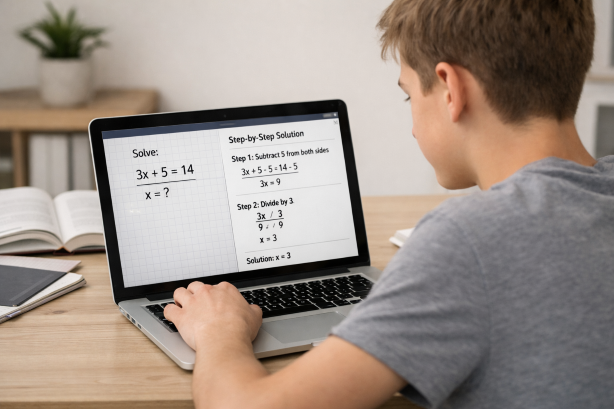
Scrny was designed specifically to address this problem. When students get stuck on a homework question, they simply take a screenshot of the problem, and Scrny’s AI analyzes it and provides help in real time.
What makes Scrny different from simply Googling the answer is its dual-mode approach:
- Answer Mode provides detailed, step-by-step solutions so students can see exactly how a problem is solved from start to finish. This is ideal for checking work or understanding the methodology behind a solution.
- Learn Mode uses a Socratic approach, asking guiding questions that lead students to discover the answer themselves. Instead of telling you that x = 7, it might ask, “What happens when you isolate the variable on the left side of the equation?”
Both modes ensure that students aren’t just getting answers—they’re building the understanding that makes homework valuable in the first place. Whether you’re tackling complex math problems, science questions, coding assignments, or multiple-choice review, Scrny acts as the tutor who’s always available when you need help most.
Tips for Making Homework More Effective in 2026
Understanding how homework helps students is only half the equation. Here’s how to maximize the benefits of every assignment.
1. Create a Consistent Study Environment
Designate a specific, distraction-free space for homework. Keep your phone in another room (or at least on Do Not Disturb), close unnecessary browser tabs, and make sure you have everything you need before you start. Consistency in your environment trains your brain to shift into “focus mode” more quickly.
2. Use the Pomodoro Technique
Work in focused 25-minute intervals followed by 5-minute breaks. After four intervals, take a longer 15–20-minute break. This technique prevents burnout, maintains concentration, and makes long homework sessions feel more manageable.
3. Start with the Hardest Subject
Your mental energy and willpower are highest at the beginning of a study session. Tackle the most challenging assignments first, when you’re freshest, and save the easier tasks for later.
4. Don’t Just Complete—Reflect
After finishing a problem or assignment, take 30 seconds to ask yourself: “What did I learn from this? Could I explain it to someone else?” This simple reflection dramatically improves retention and helps you identify areas where your understanding is still shaky.
5. Use AI Tools as Tutors, Not Shortcuts
Tools like Scrny are most effective when used to support learning, not bypass it. Try the problem yourself first. If you get stuck, use Scrny’s Learn Mode to work through it with guidance. If you’ve solved it but aren’t confident, use Answer Mode to check your work and understand any mistakes. This approach mirrors the way a good tutor operates—available when needed, but never doing the work for you.
6. Review Returned Assignments
When you get graded homework back, don’t just glance at the score and move on. Review every mistake, understand why you got it wrong, and redo the problems you missed. This is where some of the deepest learning happens.
Frequently Asked Questions
How does homework help students succeed in college and beyond?
Homework builds essential skills like time management, self-discipline, and independent problem-solving that are critical in college, where there’s far less structure and oversight. Students who develop strong homework habits in high school consistently report feeling more prepared for the demands of higher education and professional careers.
Is there such a thing as too much homework?
Yes. Research shows that excessive homework—particularly beyond the “10-minute rule” guideline—can lead to increased stress, sleep deprivation, and diminishing academic returns. The goal is meaningful, focused practice, not hours of busywork. Quality assignments that challenge thinking are always more valuable than large quantities of repetitive exercises.
How can AI homework helpers like Scrny support the learning process?
Scrny works as an on-demand tutor by analyzing screenshots of homework problems and providing either direct solutions with explanations (Answer Mode) or guided, Socratic-style coaching (Learn Mode). This means students get the support they need to push through challenging problems without bypassing the learning process. It covers math, science, coding, multiple choice, and more.
Does homework help students with different learning styles equally?
Homework can benefit all learners, but the format matters. Visual learners may benefit from diagram-based assignments, kinesthetic learners from hands-on projects, and reading/writing learners from essay-based tasks. Using supplementary tools like Scrny can help bridge gaps by providing explanations in multiple formats—step-by-step written breakdowns, visual problem analysis, and interactive guided questioning.
The evidence is clear: homework helps students build knowledge, develop critical life skills, and achieve academic success—but only when students engage with it meaningfully. The biggest threat to homework’s effectiveness isn’t the homework itself; it’s the frustration and disengagement that occur when students get stuck without support.
That’s exactly the problem Scrny was built to solve. By providing instant, intelligent help through a simple screenshot, Scrny ensures that every homework session is a productive learning experience rather than an exercise in frustration. Whether you’re working through calculus, chemistry, or computer science, Scrny gives you the guidance you need to not just finish your homework—but to actually learn from it. Visit Scrny.ai and discover how the right support can transform the way you study.
Turn a Screenshot Into an AI Answer in 3 Seconds.
Snip an image and let our AI answer generator do the rest.
Save time: no copy-pasting questions.
Stay accurate: 99 % accuracy using the latest AI answer generator technology
Monthly Subscription. Cancel anytime.
Recommended Articles

[
AI Homework Helper: Screenshot Any Question, Get Instant Answers
](https://scrny.ai/)
By Scrny.ai
[
How to Use Screenshot Homework Help: Snap a Photo, Get Step-by-Step Solutions
](https://scrny.ai/blog/screenshot-homework-help)
By Scrny.ai

[
Best AI Homework Helper 2026: Top Tools Compared
](https://scrny.ai/blog/best-ai-homework-helper)
By Scrny.ai