

You sit down at the kitchen table, and your child slides a worksheet toward you. It’s a mix of algebra, chemistry balancing equations, and a reading comprehension passage about climate policy. You glance at the problems and feel a familiar knot in your stomach — not because you never learned this material, but because it’s been decades since you’ve thought about it, and the methods have changed.
You’re not alone. Millions of parents face this exact scenario every school night. You want to help, but you’re worried about teaching the wrong method, creating an argument, or accidentally doing the work for them. The question of how to help your child with homework is more nuanced than it seems. It’s not just about finding the right answer — it’s about building study habits, fostering independence, and keeping your relationship with your kid intact in the process.
The good news is that helping kids with homework doesn’t require you to be an expert in every subject. With the right strategies, mindset, and tools — including AI-powered resources like Scrny — you can become the homework support system your child actually needs.
Why Helping Your Child with Homework Matters More Than You Think
Research consistently shows that parental involvement in education is one of the strongest predictors of a child’s academic success. But “involvement” doesn’t mean hovering over every problem or providing every answer. It means creating an environment where learning can happen, offering guidance when your child is stuck, and knowing when to step back.
When parents engage with homework in a healthy way, children develop:
- Stronger time management skills — They learn to plan, prioritize, and meet deadlines.
- Greater academic confidence — Having a supportive presence reduces anxiety around difficult material.
- Better problem-solving habits — Guided help teaches children to break challenges into manageable steps.
- A positive attitude toward learning — When homework doesn’t feel like a punishment, curiosity stays alive.
On the flip side, the wrong kind of involvement — doing the work for them, expressing frustration, or applying too much pressure — can backfire. Children may become dependent, anxious, or resentful. The goal is finding the sweet spot between support and autonomy.
How to Help Your Child with Homework: 8 Proven Strategies
Knowing how to help your child with homework effectively starts with structure, patience, and a few deliberate habits. Here are the strategies that work, backed by educators and child psychologists.
1. Create a Consistent Homework Environment
Designate a quiet, well-lit space specifically for studying. This doesn’t have to be an elaborate home office — a cleared-off kitchen table or a desk in their bedroom works fine. The key is consistency. When your child sits in that space, their brain begins to associate it with focus and productivity.
Remove distractions. Phones should be silenced or placed in another room. Background TV should be off. If your child works better with ambient noise, consider instrumental music or a white noise app.
2. Establish a Routine — But Stay Flexible
Most children thrive with a predictable after-school schedule. Maybe it’s a snack, 20 minutes of free time, then homework. Whatever the routine is, stick with it on school nights so your child knows what to expect.
That said, flexibility matters too. If your child had a particularly exhausting day or is emotionally overwhelmed, forcing them into homework mode immediately will only create conflict. Read the room and adjust when needed.
3. Ask Before You Explain
One of the most common mistakes parents make when helping kids with homework is jumping straight into explanations. Before you teach anything, ask your child:
- “What do you already understand about this problem?”
- “What part is confusing you?”
- “Have you seen something like this in class?”
These questions accomplish two things. First, they help you pinpoint exactly where the confusion lies so you’re not re-explaining concepts they already grasp. Second, they encourage your child to think critically and articulate their thought process — which is a skill that extends far beyond homework.
4. Guide, Don’t Solve
This is the golden rule of parent homework help. Your role is to be a guide, not a answer key. When your child is stuck on a math problem, resist the urge to show them the solution. Instead, walk them through the logic:
- “What’s the first step you’d normally take with this type of equation?”
- “What if we tried breaking this into smaller parts?”
- “Does your textbook have an example you can reference?”
This Socratic approach — asking questions that lead your child toward the answer — builds deeper understanding. It’s also the pedagogical philosophy behind tools like Scrny’s Learn Mode, which guides students through problems step by step rather than simply providing solutions.
5. Be Honest When You Don’t Know the Answer
Here’s a liberating truth: you don’t have to know everything. If your child brings home an AP Physics problem or a college-prep coding assignment that’s beyond your expertise, say so. Pretending to know the answer and teaching it incorrectly does more harm than admitting you’re stumped.
What you can do instead is model resourcefulness:
- Look up the concept together using reliable educational resources.
- Review the teacher’s notes or class materials with your child.
- Use an AI-powered homework helper to get a clear explanation of the topic.
Showing your child that not knowing something is the beginning of learning — not the end of it — is one of the most valuable lessons you can teach.
6. Focus on Effort, Not Perfection
Psychologist Carol Dweck’s research on growth mindset has shown that praising effort (“You worked really hard on that”) rather than outcome (“You’re so smart”) leads to more resilient, motivated learners. Apply this during homework time.
If your child struggles through a problem set and gets half of them wrong, acknowledge the struggle:
- “I can see you really pushed through that, even when it was frustrating.”
- “You stuck with it longer than last time. That’s real progress.”
This doesn’t mean ignoring mistakes. It means framing mistakes as part of the learning process rather than evidence of failure.
7. Know When to Step Away
Sometimes the most helpful thing you can do is leave the room. If homework time is consistently turning into a battle — raised voices, tears, slammed textbooks — the dynamic has become counterproductive.
In these moments, take a break. Let your child work independently for a set amount of time. If they’re still stuck afterward, revisit the problem with fresh eyes (and calmer emotions). Persistent homework conflicts may also signal that your child needs support beyond what you can provide at home, whether that’s tutoring, a conversation with the teacher, or a reliable tool they can turn to on their own.
8. Leverage the Right Tools
In 2026, parents have access to learning resources that didn’t exist even a few years ago. AI-powered homework helpers have evolved from simple answer engines into genuine educational tools that explain concepts, walk through solutions, and adapt to different learning styles.
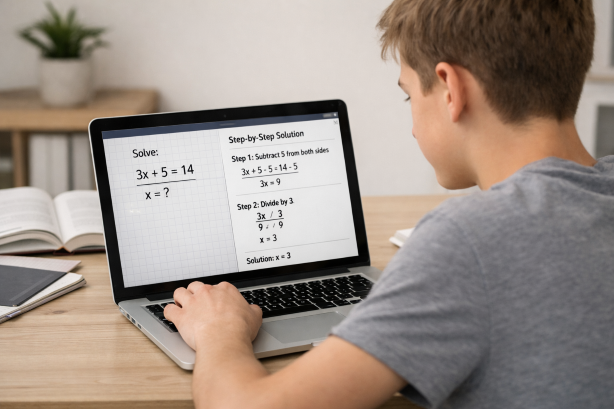
This is where tools like Scrny can be a game-changer for families. Instead of spending 45 minutes trying to recall how to factor trinomials, your child can screenshot the homework question, and Scrny’s AI provides a detailed, step-by-step explanation. You don’t have to be the math expert — but you can sit beside your child, review the explanation together, and make sure they actually understand it.
How Scrny Helps Parents Support Their Child’s Homework
Scrny was designed with exactly this scenario in mind: a student is stuck, a parent wants to help but may not have the subject expertise, and the goal is genuine learning — not just copying an answer.
Here’s how Scrny works as a homework support tool for families:
- Screenshot any question. Your child takes a screenshot of the homework problem — whether it’s a math equation, a science diagram, a multiple-choice question, or a coding challenge. Scrny’s AI analyzes the image and generates a detailed response.
- Choose Answer Mode or Learn Mode. Answer Mode provides a direct, fully worked-out solution with clear explanations. Learn Mode takes a Socratic approach, asking guiding questions and providing hints so your child reaches the answer through their own reasoning. For parents who want to encourage independent thinking, Learn Mode is particularly powerful.
- Covers every subject. Math, science, coding, social studies, language arts, and more. You don’t need to be fluent in every subject your child studies — Scrny handles the subject-matter expertise while you provide the encouragement and structure.
- Works on desktop and mobile. Scrny runs on Windows and macOS, so it fits naturally into your child’s study setup. Whether they’re working at the family computer or on their own laptop, help is a screenshot away.
The key advantage for parents is that Scrny doesn’t replace you. It supplements your involvement. You can still sit with your child, review the explanations, ask follow-up questions, and make sure the concepts are actually sinking in. It turns you from the person who has to have all the answers into the person who helps your child engage with the answers meaningfully.
Common Homework Challenges Parents Face (And How to Handle Them)
Even with the best strategies in place, specific situations can throw you off. Here’s how to handle the most common ones:
“I Hate Homework” — Dealing with Resistance
Resistance is normal, especially for younger students or those who struggle with a particular subject. Don’t dismiss the emotion. Acknowledge it (“I know this isn’t fun”) and then redirect (“Let’s just try the first three problems and see how it goes”). Breaking work into smaller chunks makes it feel less overwhelming.
The Material Has Changed Since You Were in School
Common Core math, new approaches to science education, updated history curricula — the content and methods evolve. Instead of trying to teach your child the way you learned it (which may conflict with their teacher’s approach), focus on understanding the method their class is using. Ask your child to explain how the teacher taught it. If they can’t, check class resources or use a tool like Scrny to see the problem solved using current methods.
Multiple Children, Different Needs
If you have more than one child doing homework simultaneously, you can’t be in two places at once. Stagger homework times if possible. Give older children more independence and check their work afterward. For younger children who need more hands-on support, prioritize sitting with them during the most challenging assignments.
Your Child Seems to Understand at Home But Fails Tests
This often indicates surface-level understanding. Your child may be following along with your explanations or copying the process without truly internalizing the concept. This is where Scrny’s Learn Mode is especially useful — by guiding your child to the answer through questions rather than giving it outright, it tests whether they genuinely understand or are just mimicking steps.
Frequently Asked Questions
How can I help my child with homework without doing it for them?
Focus on guiding rather than solving. Ask questions that lead your child toward the answer: “What do you think the first step is?” or “Can you explain what this question is really asking?” Tools like Scrny’s Learn Mode are built on this exact principle, providing hints and guiding questions instead of direct answers so your child develops genuine understanding.
What should I do if I don’t understand my child’s homework?
Be honest about it — there’s no shame in not remembering advanced algebra or chemistry. Model resourcefulness by looking up the concept together, reviewing class materials, or using an AI homework helper like Scrny that can analyze a screenshot of the problem and provide a clear, step-by-step explanation you can both learn from.
How much time should my child spend on homework each night?
A widely cited guideline is the “10-minute rule”: approximately 10 minutes of homework per grade level per night (so 30 minutes for a third grader, 60 minutes for a sixth grader). If your child consistently spends significantly longer than this, it may be worth discussing with their teacher to ensure the workload is appropriate or to identify specific areas where your child needs additional support.
Is using an AI homework helper considered cheating?
It depends entirely on how it’s used. Using a tool like Scrny to understand a concept, check your reasoning, or learn a method is no different from using a textbook or asking a tutor. The key is engagement: if your child reads the explanation, understands the steps, and can replicate the process independently, they’re learning. Scrny’s Learn Mode is specifically designed to promote this kind of active learning rather than passive answer-copying.
Learning how to help your child with homework is ultimately about playing the long game. You’re not just trying to get tonight’s assignment finished — you’re building habits, confidence, and a relationship with learning that will serve your child for years. The best homework help combines structure, patience, honest communication, and the right tools to fill in the gaps.
Scrny fits naturally into this equation. It gives your child expert-level explanations across every subject, supports genuine understanding through Learn Mode, and takes the pressure off you to be the expert in everything. Whether you’re helping a middle schooler with fractions or a high schooler with organic chemistry, Scrny gives your family the support it needs — one screenshot at a time. Visit scrny.ai and see how it can transform homework time from a nightly struggle into a real learning opportunity.
Turn a Screenshot Into an AI Answer in 3 Seconds.
Snip an image and let our AI answer generator do the rest.
Save time: no copy-pasting questions.
Stay accurate: 99 % accuracy using the latest AI answer generator technology
Monthly Subscription. Cancel anytime.
Recommended Articles

[
AI Homework Helper: Screenshot Any Question, Get Instant Answers
](https://scrny.ai/)
By Scrny.ai
[
How to Use Screenshot Homework Help: Snap a Photo, Get Step-by-Step Solutions
](https://scrny.ai/blog/screenshot-homework-help)
By Scrny.ai

[
Best AI Homework Helper 2026: Top Tools Compared
](https://scrny.ai/blog/best-ai-homework-helper)
By Scrny.ai