

It’s 10:30 PM on a Tuesday night. You’re staring at a worksheet full of problems you barely understand, wondering if any of this is actually helping you learn — or if you’re just going through the motions. If you’ve ever questioned whether homework is truly worth the effort, you’re far from alone. “Does homework help students learn?” is one of the most searched education questions online, and the answer is more nuanced than a simple yes or no.
The debate over homework’s effectiveness has raged among educators, parents, and students for decades. Some research suggests homework reinforces classroom learning and builds discipline. Other studies point to diminishing returns, stress, and busywork that teaches nothing at all. The truth lies somewhere in between — and it depends heavily on how you approach homework, not just whether you complete it.
Here’s the good news: when homework is done right — with genuine understanding as the goal — it can be one of the most powerful learning tools available. And in 2026, tools like Scrny are making it easier than ever to turn frustrating homework sessions into real learning opportunities. Instead of staring blankly at problems or copying answers from the internet, students can get instant, detailed explanations that actually build comprehension.
Does Homework Actually Help Students Learn? What the Research Says
The question of whether homework helps students learn has been studied extensively. Let’s look at what decades of educational research actually tell us.
The Case for Homework
Professor Harris Cooper of Duke University conducted one of the most comprehensive meta-analyses on homework, reviewing over 60 years of research. His findings showed a positive correlation between homework and academic achievement, particularly for middle and high school students. The benefits include:
- Reinforcement of classroom material: Practicing concepts independently helps transfer knowledge from short-term to long-term memory.
- Development of self-discipline: Homework teaches time management, responsibility, and independent problem-solving.
- Preparation for assessments: Students who regularly engage with material outside the classroom tend to perform better on tests and exams.
- Deeper understanding: When students wrestle with problems on their own, they often develop a more thorough grasp of the material than passive classroom listening provides.
A 2023 study published in the Journal of Educational Psychology reinforced these findings, noting that students who completed homework with a focus on understanding — rather than just completion — scored an average of 15–20% higher on unit assessments.
The Case Against (Certain Types of) Homework
Not all homework is created equal. Research also highlights significant problems:
- Busywork doesn’t help: Repetitive, low-level tasks that don’t challenge students have minimal impact on learning.
- Excessive homework causes stress: The American Psychological Association has consistently flagged homework as a top stressor for teens, and chronic stress actively impairs learning and memory.
- Diminishing returns: Cooper’s research found that beyond about 1.5–2.5 hours per night for high school students, additional homework provides no measurable academic benefit.
- Inequity: Students without access to resources, quiet study spaces, or knowledgeable adults at home are at a disadvantage — through no fault of their own.
The Bottom Line
So, does homework help students learn? Yes — but only when it’s purposeful, appropriately challenging, and approached with the intent to understand. The single biggest factor that determines whether homework helps or hurts is how students engage with it.
How Homework Improves Understanding (When Done Right)
Understanding why homework can be effective requires a quick look at how learning actually works in the brain.
The Role of Retrieval Practice
Cognitive science research consistently shows that retrieval practice — actively pulling information from memory rather than passively re-reading notes — is one of the most effective learning strategies. Homework, at its best, is retrieval practice. When you sit down and attempt to solve a physics problem from scratch, you’re forcing your brain to recall formulas, conceptual relationships, and problem-solving steps. This strengthens neural pathways far more effectively than simply reviewing notes.
Spaced Repetition and Homework
Homework also leverages the principle of spaced repetition. Instead of cramming all your learning into a single classroom session, homework spreads practice across time. Research from the University of California found that students who engaged with material across multiple sessions retained 40–60% more information after 30 days compared to those who only studied in one sitting.
The Struggle Is the Point
Here’s something counterintuitive: the moments when homework feels hardest are often when you’re learning the most. Psychologists call this desirable difficulty — the productive struggle that occurs when a task is challenging but not impossible. If homework feels too easy, you’re probably not learning much. If it feels impossibly hard with no support, you’re likely to give up.
The sweet spot is that zone where you’re challenged but have access to the guidance you need to push through. This is exactly where modern AI tools like Scrny become valuable — they provide that guidance on demand, turning a moment of frustration into a moment of genuine understanding.
The Difference Between Completing Homework and Learning from Homework
There’s a critical distinction that many students miss: finishing your homework and learning from your homework are not the same thing.
Completion-Oriented Approach (Less Effective)
- Rushing through problems to get them done
- Copying solutions from answer keys, friends, or the internet
- Moving on immediately after getting a wrong answer without understanding why
- Prioritizing speed over comprehension
- Treating homework as a box to check
Learning-Oriented Approach (Highly Effective)
- Taking time to understand each step of a solution
- Asking “why” when a method works, not just “what” the answer is
- Reviewing mistakes and understanding the reasoning behind correct answers
- Connecting new problems to concepts learned in class
- Using resources that explain processes, not just provide answers
Research from Stanford University’s Challenge Success project found that students who spent less time on homework but engaged more deeply with the material outperformed peers who spent hours on passive, completion-focused studying.
This is why the design philosophy behind Scrny’s Learn Mode matters so much. Instead of simply handing you an answer, Learn Mode walks you through problems step by step, asking guiding questions that help you arrive at the solution yourself — mimicking the Socratic method that educators have used for centuries.
Practical Tips to Make Homework Actually Help You Learn
Whether you’re a student trying to get more out of your study time or a parent wondering how to support your child, these evidence-based strategies can transform homework from a chore into a genuine learning tool.
1. Start with What You Don’t Know
It’s tempting to begin with easy problems to build momentum, but research suggests tackling your hardest material first — when your mental energy is highest — leads to better outcomes. Save the easier review problems for later in the session.
2. Eliminate Distractions (Seriously)
A 2024 study from the University of Chicago found that students who studied with their phone in another room scored significantly higher on subsequent tests than those who had their phone on the desk — even if the phone was face down and silenced. Your environment matters.
3. Use the “Explain It” Test
After solving a problem, try explaining the solution out loud as if you were teaching someone else. If you can’t articulate why each step works, you haven’t truly learned it. This technique, called the Feynman Method, is one of the most effective study strategies ever documented.
4. Don’t Just Find Answers — Find Explanations
When you’re stuck, the quality of help you seek matters enormously. Googling the answer to a specific problem teaches you nothing. Getting a detailed, step-by-step explanation of how to solve that type of problem teaches you everything. This is the difference between copying and comprehending.
5. Take Strategic Breaks
The Pomodoro Technique — 25 minutes of focused work followed by a 5-minute break — aligns with research on attention spans and cognitive performance. Your brain needs recovery time to consolidate learning.
6. Review Your Mistakes
Keeping an “error log” where you write down problems you got wrong and the correct reasoning is one of the highest-leverage study habits. Mistakes aren’t failures — they’re data about where your understanding has gaps.
Why Students in 2026 Are Turning to Scrny for Smarter Homework Help
The fundamental challenge with homework hasn’t changed: students get stuck, and getting unstuck has historically been difficult. You can’t always reach your teacher at 10 PM. Tutors are expensive. Textbook explanations are often confusing. And searching the internet for answers usually gives you the solution without the understanding.
Scrny was built specifically to solve this problem. Here’s how it transforms the homework experience:
Screenshot Any Question, Get Instant Help
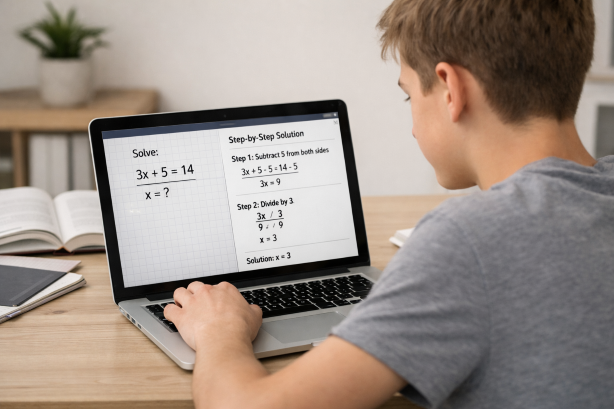
Whether it’s a calculus equation, a chemistry diagram, a coding assignment, or a multiple-choice history question, Scrny lets you screenshot your homework and receive a detailed analysis within seconds. No typing out complex equations. No trying to describe your problem in a search engine. Just capture what’s on your screen and get help immediately.
Two Modes for Two Goals
- Answer Mode: When you need to check your work or understand a solution quickly, Answer Mode provides comprehensive, step-by-step solutions with full explanations of the reasoning behind each step.
- Learn Mode: When you want to truly master the material, Learn Mode guides you through the problem with questions and hints — helping you develop the problem-solving skills you need for exams and beyond.
Built for Real Student Workflows
Scrny runs as a desktop application on both Windows and macOS, fitting seamlessly into how students actually study — at their computers, with their coursework open. There’s no need to switch between browser tabs or navigate clunky web interfaces.
Covers Every Subject
From AI-powered math help to science, coding, and humanities, Scrny’s AI is trained to handle the full range of academic subjects students encounter in middle school, high school, and college.
The key difference between Scrny and simply looking up answers online is the emphasis on understanding. Every explanation is designed to help you learn, not just finish. That’s what makes it a tool that actually answers “yes” to the question: does homework help students learn?
Frequently Asked Questions
Does homework help students learn more effectively than classroom instruction alone?
Research consistently shows that homework combined with classroom instruction produces better learning outcomes than classroom instruction alone — particularly for students in grades 7 and above. The key is that homework provides additional retrieval practice and spaced repetition, both of which strengthen long-term memory. However, the quality and purpose of the homework matter more than the quantity.
How much homework actually helps students learn without causing burnout?
The general guideline supported by research is the “10-minute rule”: approximately 10 minutes of homework per grade level per night (e.g., 60 minutes for a 6th grader, 120 minutes for a 12th grader). Beyond about 2–2.5 hours for high school students, additional homework shows no measurable academic benefit and can increase stress, which actively impairs learning.
Is using an AI homework helper like Scrny considered cheating?
Using Scrny as a learning tool — to understand concepts, check your reasoning, and work through problems step by step — is no different from working with a tutor or using a textbook’s solution manual. The intent matters. Scrny’s Learn Mode is specifically designed to teach you how to solve problems yourself, not to bypass the learning process. As with any resource, the goal should be understanding, not just completion.
What types of homework are most beneficial for student learning?
Research identifies several types of homework that produce the strongest learning outcomes: problems that require applying concepts to new situations, assignments that build on classroom discussion, projects that encourage critical thinking, and practice that targets specific skill gaps. Rote memorization and busywork consistently rank as the least effective types of homework for promoting genuine understanding.
The question “does homework help students learn?” doesn’t have a one-size-fits-all answer — but the evidence is clear that homework done with intention, focus, and the right support can be transformative. The difference between homework that wastes your time and homework that builds real knowledge comes down to how you engage with it. Active problem-solving, seeking explanations over answers, and embracing productive struggle are the keys to turning every assignment into a learning opportunity.
If you’re ready to make your homework sessions more productive and less frustrating, Scrny is designed to help you do exactly that. Screenshot any problem, get clear explanations, and choose whether you want direct solutions or guided learning. Because the real question isn’t whether homework can help you learn — it’s whether you have the right tools to make sure it does. Download Scrny today and start studying smarter.
Turn a Screenshot Into an AI Answer in 3 Seconds.
Snip an image and let our AI answer generator do the rest.
Save time: no copy-pasting questions.
Stay accurate: 99 % accuracy using the latest AI answer generator technology
Monthly Subscription. Cancel anytime.
Recommended Articles

[
AI Homework Helper: Screenshot Any Question, Get Instant Answers
](https://scrny.ai/)
By Scrny.ai
[
How to Use Screenshot Homework Help: Snap a Photo, Get Step-by-Step Solutions
](https://scrny.ai/blog/screenshot-homework-help)
By Scrny.ai

[
Best AI Homework Helper 2026: Top Tools Compared
](https://scrny.ai/blog/best-ai-homework-helper)
By Scrny.ai