
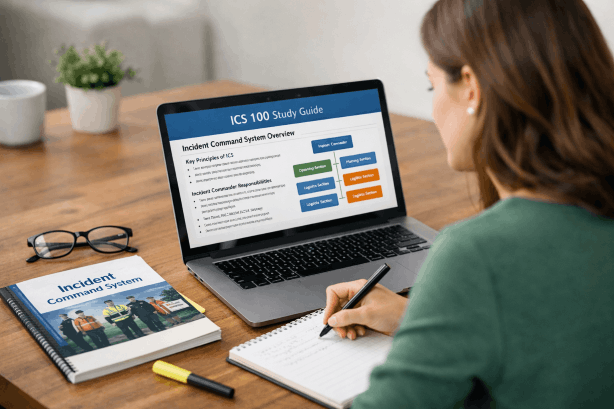
ICS 100 (Introduction to the Incident Command System) is a foundational FEMA course required for emergency responders, government employees, and many private sector personnel. The final exam tests your understanding of ICS principles, organizational structure, and management concepts. Whether you’re a first responder, emergency manager, or volunteer, passing this course demonstrates competency in standardized incident management.
Scrny helps you prepare by explaining concepts and practice questions you encounter during study. Screenshot any confusing material and get a clear explanation that strengthens your understanding of the Incident Command System.
What Is ICS 100?
ICS 100 (IS-100.c) is a web-based course offered free through FEMA’s Emergency Management Institute. It introduces the Incident Command System, a standardized approach to incident management used across the United States.
The course covers:
- ICS fundamentals and features
- The National Incident Management System (NIMS)
- Organizational structure and positions
- Incident facilities and resources
- Common responsibilities and transfer of command
Completion provides a certificate and often fulfills job requirements for emergency management, healthcare, education, and public safety positions.
Core ICS Principles
Understanding these foundational principles is essential for the exam:
Common Terminology
ICS uses standardized terminology to ensure clear communication:
- Organizational functions have consistent names (Operations, Planning, Logistics, Finance/Administration)
- Resources are described using common terms
- Facilities are named consistently (Incident Command Post, Staging Area, Base)
This standardization allows personnel from different agencies to work together effectively.
Modular Organization
ICS structure expands or contracts based on incident needs:
- Small incidents may only need an Incident Commander
- Larger incidents activate additional sections and positions
- The organization builds from the top down
- Only positions needed are filled
Management by Objectives
Incidents are managed through a systematic process:
- Understand agency policy and direction
- Assess incident situation
- Establish incident objectives
- Select appropriate strategy
- Apply tactics and monitor performance
- Adjust as needed
Incident Action Planning
Formal planning ensures coordinated response:
- Incident Action Plans (IAPs) document objectives and assignments
- Planning cycles match operational periods
- All responders understand their roles and the overall strategy
Manageable Span of Control
Supervisors maintain effective oversight through limited direct reports:
- Optimal range: 3 to 7 subordinates
- Recommended: 5 subordinates
- Ratios outside this range indicate organizational problems
Incident Facilities and Locations
Standard facilities support operations:
- Incident Command Post (ICP) – Where command functions are performed
- Staging Area – Where resources await assignment
- Base – Primary support activities location
- Camp – Separate location for food, water, rest
- Helibase/Helispot – Aviation support locations
Comprehensive Resource Management
Resources are systematically managed:
- Categorized by type and capability
- Tracked from mobilization through demobilization
- Assigned through established processes
Integrated Communications
Communication systems ensure information sharing:
- Common communications plans
- Interoperable equipment procedures
- Clear protocols for information flow
Establishment and Transfer of Command
Clear command authority is maintained:
- Command is established at the beginning of every incident
- Transfer follows documented procedures
- Briefings ensure continuity
Unified Command
Multiple agencies maintain coordinated response:
- Jurisdictions or agencies with responsibility work together
- Single set of incident objectives
- Coordinated strategies and resources
Accountability
Personnel and resources are tracked:
- Check-in procedures for all responders
- Resource status tracking
- Unity of command (one supervisor per person)
ICS Organizational Structure
Command Staff
Positions that report directly to the Incident Commander:
Public Information Officer (PIO)
- Interface with media and public
- Coordinate information release
- Manage rumors and misinformation
Safety Officer
- Monitor safety conditions
- Develop safety plan
- Authority to stop unsafe actions
Liaison Officer
- Contact point for assisting agencies
- Coordinate outside agency involvement
General Staff
Section Chiefs who manage functional areas:
Operations Section Chief
- Manages tactical operations
- Directs resources in the field
- Implements Incident Action Plan tactics
Planning Section Chief
- Collects and analyzes information
- Develops Incident Action Plans
- Tracks resources and documentation
Logistics Section Chief
- Provides resources and services
- Manages communications, food, medical, supplies
- Supports operational needs
Finance/Administration Section Chief
- Tracks costs and reimbursement
- Manages contracts and procurement
- Handles compensation claims
Common ICS 100 Test Questions
The exam typically covers:
Organizational Questions
- Who does the Safety Officer report to? (Incident Commander)
- What are the four General Staff sections? (Operations, Planning, Logistics, Finance/Admin)
- What’s the recommended span of control? (5, with range of 3-7)
Principle Application
- Scenarios asking which ICS principle applies
- Questions about when to expand or contract organization
- Transfer of command procedures
Terminology
- Definitions of key ICS terms
- Identifying correct facility names
- Understanding resource management concepts
NIMS Integration
- How ICS relates to the National Incident Management System
- Compliance requirements
- Multi-agency coordination
How Scrny Helps You Study
Scrny enhances your ICS 100 preparation:
Clarify Confusing Concepts
The relationships between ICS positions and their responsibilities can be complex. Screenshot diagrams or explanations that aren’t clear and get simplified breakdowns.
Practice Question Support
When practice questions have you stumped, Scrny explains the reasoning behind correct answers. Understanding why helps you handle variations on the exam.
Quick Reference
Studying between shifts or other obligations? Get instant answers to questions about specific concepts without searching through course materials.
Reinforce Key Points
Use Scrny to review critical information like span of control numbers, organizational relationships, and terminology definitions.
Study Tips for ICS 100
Focus on the Fundamentals
The exam tests core principles more than obscure details. Make sure you thoroughly understand:
- The 14 NIMS management characteristics
- Command and General Staff positions
- Span of control guidelines
- Transfer of command process
Learn the Organizational Chart
Visualize how positions relate:
- Incident Commander at top
- Command Staff (PIO, Safety, Liaison) reporting to IC
- General Staff (Operations, Planning, Logistics, Finance) as section chiefs
Understand Real Application
Think about how ICS would work at an actual incident. This context helps you answer scenario-based questions correctly.
Don’t Rush the Course
The modules contain the information you need. Take notes on key points rather than clicking through quickly.
Use the Course Materials
FEMA provides student manuals and job aids. These are your primary study resources—Scrny helps when those materials need clarification.
Why ICS Certification Matters
ICS 100 completion is required for:
- Federal emergency management positions
- Many state and local government roles
- Hospital and healthcare emergency preparedness
- School district emergency coordinators
- Utility company emergency responders
- Volunteer organizations (Red Cross, CERT, etc.)
Beyond job requirements, ICS knowledge prepares you to function effectively during real emergencies when standardized management saves lives.
──────────────────────────────────────────────────
Frequently Asked Questions
How hard is the ICS 100 final exam?
The exam is straightforward if you completed the course attentively. Questions come directly from course content. Most people pass on the first attempt.
What score do I need to pass ICS 100?
You need 75% or higher to pass the final exam.
How many questions are on the ICS 100 test?
The final exam has 25 questions.
Can I retake the ICS 100 exam if I fail?
Yes, you can retake the exam. Review the areas where you struggled before attempting again.
How long is ICS 100 valid?
The certificate doesn’t expire, but many organizations recommend periodic refresher training, especially when course content is updated.
Is ICS 100 free?
Yes, FEMA offers IS-100 at no cost through the Emergency Management Institute website.
──────────────────────────────────────────────────
Preparing for your ICS 100 final exam? Use Scrny to study smarter—screenshot any confusing concept or practice question and get clear explanations that help you pass with confidence.
Turn a Screenshot Into an AI Answer in 3 Seconds.
Snip an image and let our AI answer generator do the rest.
Save time: no copy-pasting questions.
Stay accurate: 99 % accuracy using the latest AI answer generator technology
Monthly Subscription. Cancel anytime.
Recommended Articles

[
AI Homework Helper: Screenshot Any Question, Get Instant Answers
](https://scrny.ai/)
By Scrny.ai

[
How to Use Screenshot Homework Help: Snap a Photo, Get Step-by-Step Solutions
](https://scrny.ai/blog/screenshot-homework-help)
By Scrny.ai

[
Homework Helper Learn Mode: Get Guided to the Right Answer
](https://scrny.ai/blog/learn-mode-homework-helper)
By Scrny.ai