
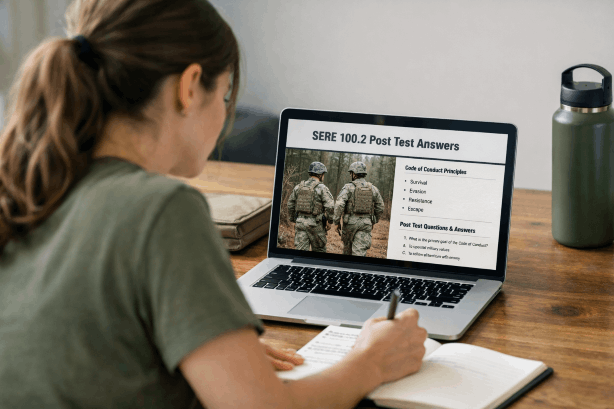
SERE 100.2 (Survival, Evasion, Resistance, and Escape) Level A training is mandatory for Department of Defense personnel at risk of isolation or capture. The post-test assesses your understanding of the Code of Conduct, evasion principles, survival techniques, and behavior expectations if detained. This knowledge isn’t just for passing a test—it could be critical in real situations.
Scrny can help you study by explaining concepts and practice questions you encounter during preparation. Screenshot any training material or practice question, and get a clear explanation that reinforces your understanding of this important content.
What Is SERE 100.2?
SERE 100.2 is a computer-based training course that provides foundational knowledge for military and DoD personnel. It covers:
- Survival – Basic techniques to sustain life in hostile environments
- Evasion – Methods to avoid capture by hostile forces
- Resistance – How to resist exploitation while in captivity
- Escape – Principles for returning to friendly control
Level A is the introductory tier, providing awareness-level training. Higher SERE levels involve more intensive classroom and field instruction.
The Code of Conduct
The Code of Conduct is central to SERE training. Understanding its six articles is essential for the post-test:
Article I
I am an American, fighting in the forces which guard my country and our way of life. I am prepared to give my life in their defense.
This establishes the commitment and mindset expected of service members.
Article II
I will never surrender of my own free will. If in command, I will never surrender the members of my command while they still have the means to resist.
Surrender is a last resort when all means of resistance are exhausted.
Article III
If I am captured I will continue to resist by all means available. I will make every effort to escape and to aid others to escape. I will accept neither parole nor special favors from the enemy.
Resistance and escape attempts are duties, not optional choices.
Article IV
If I become a prisoner of war, I will keep faith with my fellow prisoners. I will give no information nor take part in any action which might be harmful to my comrades. If I am senior, I will take command. If not, I will obey the lawful orders of those appointed over me and will back them up in every way.
Maintaining military structure and loyalty even in captivity.
Article V
When questioned, should I become a prisoner of war, I am required to give name, rank, service number, and date of birth. I will evade answering further questions to the utmost of my ability. I will make no oral or written statements disloyal to my country and its allies or harmful to their cause.
This establishes what information can be given and the duty to resist further interrogation.
Article VI
I will never forget that I am an American, fighting for freedom, responsible for my actions, and dedicated to the principles which made my country free. I will trust in my God and in the United States of America.
Maintaining identity and values throughout any ordeal.
Key SERE 100.2 Topics
Survival Principles
The course covers basic survival concepts:
The Survival Mindset
- Maintaining will to survive
- Managing stress and fear
- Making sound decisions under pressure
SURVIVAL Acronym
- S – Size up the situation
- U – Use all your senses
- R – Remember where you are
- V – Vanquish fear and panic
- I – Improvise and improve
- V – Value living
- A – Act like the natives
- L – Learn basic skills
Basic Needs Priorities
Understanding the hierarchy: immediate security, first aid, shelter, water, food.
Evasion Concepts
When to Evade
Understanding situations where evasion is appropriate versus when other options exist.
Movement Principles
- Travel during optimal conditions
- Avoid detection
- Navigate toward recovery assets
- Leave minimal evidence of passage
Recovery Operations
How personnel recovery works and your role in facilitating it.
Resistance Principles
Exploitation Methods
Understanding how adversaries may attempt to exploit captives through:
- Interrogation techniques
- Propaganda purposes
- Psychological manipulation
Resistance Strategies
- Providing only authorized information
- Resisting without unnecessarily provoking harm
- Maintaining communication with fellow captives
- Protecting classified information
Legal Considerations
Prisoner of War Status
Understanding Geneva Convention protections and what constitutes lawful treatment.
Unlawful Detention
How treatment may differ when captured by non-state actors or in irregular conflicts.
Common Post-Test Question Areas
The assessment typically covers:
Code of Conduct Application
Questions present scenarios and ask how the Code of Conduct applies. You need to identify which article is relevant and what behavior it requires.
Survival Priority Questions
Given a scenario, what should be addressed first? These test your understanding of the priority hierarchy.
Evasion Decisions
When is evasion appropriate? What factors influence the decision to evade versus other options?
Resistance Scenarios
If captured, what information can you provide? How should you respond to various interrogation approaches?
Legal Knowledge
Questions about rights under the Geneva Convention and the legal framework governing captivity.
How Scrny Helps You Study
Scrny supports your SERE 100.2 preparation:
Concept Clarification
When training explanations are unclear, screenshot the content and get a clearer breakdown. Understanding the reasoning behind principles helps you apply them to varied scenarios.
Practice Question Analysis
Screenshot practice questions to understand why certain answers are correct. This is especially valuable for scenario-based questions where multiple options seem plausible.
Review Key Points
If you’re struggling to remember the Code of Conduct articles or survival priorities, Scrny can help reinforce the content through explanation and context.
Study Flexibility
Whether you’re preparing between duties, during travel, or at home, Scrny provides instant assistance whenever you’re studying.
Study Tips for SERE 100.2
Understand the “Why”
Don’t just memorize the Code of Conduct words—understand the principles behind each article. When you understand why, you can apply the concepts to unfamiliar scenarios.
Focus on Scenario Application
The test uses scenario-based questions. Practice thinking through situations: What’s happening? Which principles apply? What’s the correct response?
Review the Acronyms
SERE training uses several memory aids. Make sure you know what each letter stands for in acronyms like SURVIVAL.
Know the Hierarchy
Survival priorities, resistance approaches, and decision frameworks have specific orders. Know what comes first, second, third.
Connect to Real Situations
Think about how these principles would apply in actual situations. This deeper engagement helps retention better than passive reading.
Why This Training Matters
SERE principles aren’t academic exercises. Service members have faced capture and isolation situations where this training made the difference between survival and tragedy, between maintaining honor and making regrettable choices under pressure.
Taking the training seriously—not just passing the test—prepares you for possibilities you hope never occur.
──────────────────────────────────────────────────
Frequently Asked Questions
How difficult is the SERE 100.2 post test?
The test is moderately challenging, especially the scenario-based questions. Personnel who paid attention during the training modules generally pass. Those who clicked through quickly may need to review.
What score do I need to pass SERE 100.2?
Passing requirements vary by command, but typically 80% is the minimum passing score. Check your specific requirements.
Can I retake the SERE 100.2 test?
Yes, retakes are generally allowed after additional review time. Use Scrny to study the concepts you struggled with.
How long is the SERE 100.2 course?
The complete course, including pre-test, modules, and post-test, typically takes 2-4 hours depending on your pace.
Is SERE 100.2 classified?
The Level A course is unclassified and provides foundational awareness. Higher SERE levels may include controlled information.
──────────────────────────────────────────────────
Preparing for your SERE 100.2 post test? Use Scrny to reinforce your understanding—screenshot any concept or practice question and get clear explanations that help the material stick.
Turn a Screenshot Into an AI Answer in 3 Seconds.
Snip an image and let our AI answer generator do the rest.
Save time: no copy-pasting questions.
Stay accurate: 99 % accuracy using the latest AI answer generator technology
Monthly Subscription. Cancel anytime.
Recommended Articles

[
AI Homework Helper for Multiple Choice Questions: Get Answers Explained
](https://scrny.ai/blog/multiple-choice-homework-helper)
By Scrny.ai

[
How to Use Screenshot Homework Help: Snap a Photo, Get Step-by-Step Solutions
](https://scrny.ai/blog/screenshot-homework-help)
By Scrny.ai

[
AI Math Homework Helper: Solve Any Problem with a Screenshot
](https://scrny.ai/blog/ai-math-homework-helper)
By Scrny.ai