
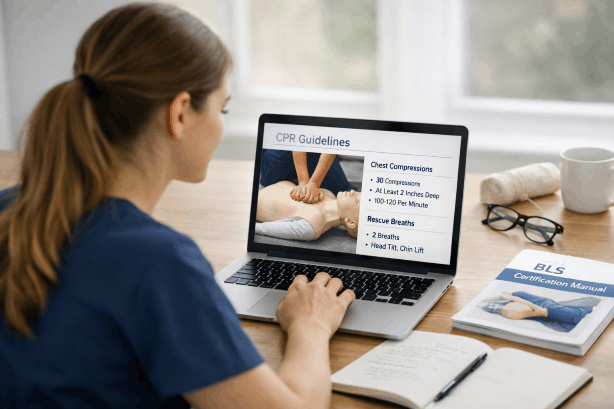
Basic Life Support (BLS) certification is essential for healthcare providers, first responders, and anyone who may need to respond to cardiac emergencies. The BLS exam tests your knowledge of CPR techniques, AED operation, and emergency response protocols. Getting certified—and staying current—can mean the difference between life and death in a cardiac emergency.
Scrny helps you prepare by explaining practice questions and concepts you encounter during study. Screenshot any confusing material from your BLS course and get a clear explanation that reinforces your understanding of these critical skills.
What Is BLS Certification?
BLS (Basic Life Support) is a certification program that teaches lifesaving techniques for cardiac arrest and other life-threatening emergencies. The American Heart Association (AHA) and American Red Cross are the primary certifying organizations.
BLS training covers:
- High-quality CPR for adults, children, and infants
- AED operation (Automated External Defibrillator)
- Choking relief for responsive and unresponsive victims
- Team-based resuscitation for healthcare settings
- Bag-mask ventilation techniques
Healthcare providers, including nurses, physicians, EMTs, paramedics, and medical students, typically need BLS certification. Many workplaces also require it for fitness instructors, lifeguards, and childcare workers.
Critical BLS Numbers to Know
The BLS exam tests specific ratios and measurements. Memorize these:
CPR Compression-to-Ventilation Ratios
Rescuer Type
Adult
Child
Infant
1 Rescuer
30:2
30:2
30:2
2 Rescuers (Healthcare)
30:2
15:2
15:2
Compression Depth
- Adults: At least 2 inches (5 cm), no more than 2.4 inches (6 cm)
- Children: About 2 inches (5 cm), at least one-third chest depth
- Infants: About 1.5 inches (4 cm), at least one-third chest depth
Compression Rate
- All ages: 100 to 120 compressions per minute
Other Key Numbers
- AED analysis: Every 2 minutes
- Pulse check: No more than 10 seconds
- Breath duration: 1 second per breath
- Chest recoil: Allow complete recoil between compressions
The Chain of Survival
Understanding the Chain of Survival helps you answer scenario-based questions:
Out-of-Hospital Chain of Survival (Adults)
- Recognition and activation – Recognize cardiac arrest, call 911
- Early CPR – Immediate high-quality CPR
- Rapid defibrillation – AED use as soon as available
- Advanced resuscitation – EMS and advanced care
- Post-cardiac arrest care – Hospital treatment
- Recovery – Long-term rehabilitation and support
In-Hospital Chain of Survival
- Surveillance and prevention – Detect deterioration early
- Recognition and activation – Recognize arrest, activate response
- High-quality CPR – Immediate compressions
- Defibrillation – Rapid AED/defibrillator use
- Post-cardiac arrest care – ICU and specialized treatment
- Recovery – Rehabilitation planning
High-Quality CPR Components
The exam emphasizes what makes CPR effective:
Compression Quality
- Rate: 100-120 per minute
- Depth: At least 2 inches for adults
- Recoil: Full chest recoil between compressions
- Interruptions: Minimize pauses (less than 10 seconds)
- Fraction: Chest compression fraction should be at least 60%
Ventilation Quality
- Visible chest rise with each breath
- Avoid excessive ventilation (can impair blood return)
- 1 second per breath
- Don’t interrupt compressions for more than 10 seconds
AED Operation
AED questions are common on BLS exams:
Basic AED Steps
- Power on the AED
- Attach pads to bare, dry chest
- Clear the victim during analysis
- Deliver shock if advised (ensure no one touching victim)
- Resume CPR immediately after shock
Special AED Considerations
Water: Move victim to dry surface, dry chest before applying pads
Medication patches: Remove patch, wipe area, then apply AED pad
Implanted devices: Place pad at least 1 inch away from device
Excessive chest hair: If pads don’t stick, shave or remove hair
Children under 8 or under 55 lbs: Use pediatric pads if available; if not, use adult pads
Infants: Manual defibrillator preferred; AED with pediatric attenuator acceptable; adult AED as last resort
Choking Management
Responsive Adult or Child (Severe Obstruction)
- Ask “Are you choking?” – if they can’t speak/cough, act
- Give abdominal thrusts (Heimlich maneuver)
- Repeat until object expelled or victim becomes unresponsive
Responsive Infant (Severe Obstruction)
- Support infant face-down on forearm
- Give 5 back slaps between shoulder blades
- Turn infant face-up
- Give 5 chest thrusts (same location as CPR)
- Repeat sequence until clear or unresponsive
Unresponsive Choking Victim
- Lower to ground, call for help
- Begin CPR (30 compressions)
- Before giving breaths, look in mouth for visible object
- Remove object only if you can see it
- Attempt ventilation
- Continue CPR cycle
Team Dynamics in Resuscitation
BLS for healthcare providers emphasizes team response:
Team Roles
- Team leader – Directs efforts, assigns roles, monitors quality
- Compressor – Performs chest compressions
- Airway manager – Manages ventilation
- AED/monitor operator – Operates defibrillator
- Timer/recorder – Tracks time, documents events
- Medication administrator – Gives drugs when indicated
Effective Team Behaviors
- Clear communication – Closed-loop communication
- Role clarity – Everyone knows their assignment
- Mutual respect – Value all team members’ input
- Constructive feedback – Improve performance without blame
Common BLS Test Question Types
Scenario Questions
“You find an unresponsive adult with no pulse. After calling 911, what is your next action?”
Answer: Begin CPR starting with chest compressions
Ratio Questions
“What is the compression-to-ventilation ratio for two-rescuer infant CPR?”
Answer: 15:2
Sequence Questions
“Place the following AED steps in order…”
Tests your understanding of proper AED operation sequence
Best Practice Questions
“Which compression rate is correct for adult CPR?”
Answer: 100-120 compressions per minute
How Scrny Helps You Study
Scrny enhances BLS preparation:
Explain Practice Questions
When BLS practice tests leave you confused, screenshot the question. Scrny explains why the correct answer is right and why other options are wrong.
Clarify Protocols
BLS has specific sequences that must be followed. If you’re uncertain about the order of steps, Scrny provides clear explanations.
Reinforce Key Numbers
Compression rates, depths, and ratios are testable facts. Use Scrny to review and confirm your understanding of critical numbers.
Study Anytime
Whether you’re cramming before your certification exam or reviewing during a break, Scrny provides instant help.
Study Tips for BLS Certification
Master the Numbers
Ratios, rates, and depths appear on every BLS exam. Make flashcards or use repetition until these numbers are automatic.
Understand the Why
Knowing why you do 30:2 (allows adequate blood flow) helps you remember better than pure memorization.
Practice Scenarios
Think through different situations: What if the victim is wet? What if they’re a child? Scenario practice prepares you for varied questions.
Take a Hands-On Course
The written exam is one component. Skills testing requires demonstrating proper technique. Practice on manikins if possible.
Review AHA Guidelines
BLS guidelines are updated periodically. Make sure your study materials reflect current recommendations.
──────────────────────────────────────────────────
Frequently Asked Questions
How hard is the BLS certification exam?
The written exam is moderately easy if you’ve completed the course and studied the key numbers. Most people pass on the first attempt with adequate preparation.
What score do I need to pass BLS?
Most certifying organizations require 84% or higher (21 of 25 questions correct for AHA).
How long is BLS certification valid?
BLS certification is typically valid for 2 years, after which you need to recertify.
Can I get BLS certified online?
Many organizations offer blended courses with online learning and in-person skills testing. Fully online certification may not be accepted by all employers.
What’s the difference between BLS and CPR certification?
BLS is designed for healthcare providers and includes team dynamics, bag-mask ventilation, and more advanced content. Basic CPR/AED courses are for lay rescuers.
──────────────────────────────────────────────────
Preparing for your BLS certification exam? Use Scrny to study effectively—screenshot any practice question or confusing concept and get clear explanations that help you pass and save lives.
Turn a Screenshot Into an AI Answer in 3 Seconds.
Snip an image and let our AI answer generator do the rest.
Save time: no copy-pasting questions.
Stay accurate: 99 % accuracy using the latest AI answer generator technology
Monthly Subscription. Cancel anytime.
Recommended Articles
[
AI Homework Helper: Screenshot Any Question, Get Instant Answers
](https://scrny.ai/)
By Scrny.ai
[
How to Use Screenshot Homework Help: Snap a Photo, Get Step-by-Step Solutions
](https://scrny.ai/blog/screenshot-homework-help)
By Scrny.ai

[
Best AI Homework Helper 2026: Top Tools Compared
](https://scrny.ai/blog/best-ai-homework-helper)
By Scrny.ai