
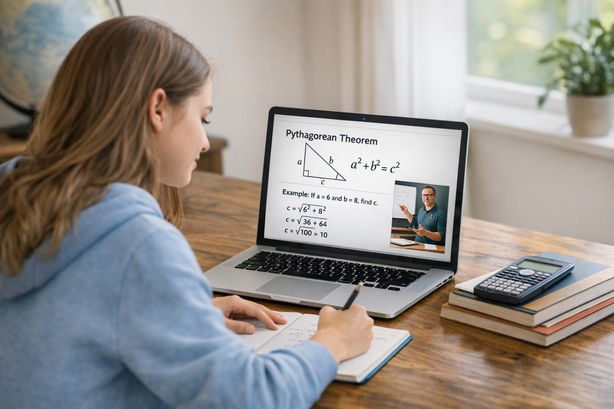
One equation from your geometry homework will follow you further than almost any other — into trigonometry, physics, engineering, even the distance calculations behind a GPS route:
a² + b² = c² — in a right triangle, the square of the hypotenuse equals the sum of the squares of the two legs.
Three conditions hide inside that sentence, and most lost homework marks come from ignoring one of them: the triangle must have a right angle; c must be the side opposite that right angle (the hypotenuse — always the longest side); and the equation relates the squares of the sides, not the sides themselves.
Why it's true (60-second version)
You don't have to take the theorem on faith — one classic argument fits in a paragraph.
Take four identical right triangles with legs a, b and hypotenuse c. Arrange them inside a square of side (a + b), corners pointing in, so their hypotenuses frame a tilted inner square of side c. The big square's area can be counted two ways:
- as a square: (a + b)² = a² + 2ab + b²
- as its parts: four triangles plus the inner square: 4 · (ab/2) + c² = 2ab + c²
Same area, so a² + 2ab + b² = 2ab + c². Subtract 2ab from both sides and the theorem falls out: a² + b² = c². No trigonometry required — just area counted twice.
Worked problem 1 — find the hypotenuse
A right triangle has legs 9 cm and 12 cm. How long is the hypotenuse?
- Identify the parts: legs a = 9, b = 12; hypotenuse c unknown.
- Apply the theorem: c² = 9² + 12² = 81 + 144 = 225
- Undo the square: c = √225 = 15 cm
Sanity check: 9-12-15 is the 3-4-5 triple scaled by 3, and 15 is longer than both legs — as a hypotenuse must be.
Worked problem 2 — find a leg (the one everyone gets wrong)
A right triangle has hypotenuse 13 m and one leg 5 m. Find the other leg.
The trap: the unknown is not c this time. The known 13 is the hypotenuse, so it goes on the right-hand side alone:
- a² + b² = c² → 5² + b² = 13²
- Subtract, don't add: b² = 169 − 25 = 144
- b = √144 = 12 m
Watch what happens if you add out of habit: √(169 + 25) = √194 ≈ 13.9 — an answer longer than the hypotenuse, which is geometrically impossible. That impossibility is a free error alarm: if your "leg" comes out longer than the hypotenuse, you added when you should have subtracted.
Worked problem 3 — distance, disguised
A hiker walks 8 km due east, then 15 km due north. How far is she from her starting point?
No triangle is mentioned — you have to see it. East and north are perpendicular, so the two walked legs form a right angle, and the straight-line distance home is the hypotenuse:
- d² = 8² + 15² = 64 + 225 = 289
- d = √289 = 17 km
This is the pattern behind the coordinate distance formula: d = √((x₂−x₁)² + (y₂−y₁)²) is the Pythagorean theorem, with the coordinate differences as legs. Word problems about ladders on walls, ramps, kite strings and TV screen diagonals all reduce to the same move: find the perpendicular pair, then Pythagoras.
The four classic mistakes
Adding when solving for a leg. Covered above — and it's mistake #1 by a wide margin. Rule of thumb: the hypotenuse is alone on one side of the equation; if you know it, you subtract.
Forgetting the square root. b² = 144 is not the answer; b = 12 is. If your homework answer is suspiciously huge (144 m for a ladder problem), you stopped one step early.
Using it on a non-right triangle. No right angle, no theorem. A triangle with sides 4, 5, 6 simply doesn't satisfy it: 4² + 5² = 41 ≠ 36 = 6². For those you need the Law of Cosines.
Crowning the wrong hypotenuse. In a printed diagram the right angle isn't always bottom-left. Find the little square marking the 90° angle; the side opposite it is c — regardless of how the triangle is rotated.
The converse: a right-angle detector
The theorem also runs backwards, and homework sets love this: if a² + b² = c² for the longest side c, the triangle is right-angled.
Is a triangle with sides 7, 24, 25 a right triangle? Check: 7² + 24² = 49 + 576 = 625 = 25². Yes — right angle opposite the 25.
The comparison even tells you more: for the 4-5-6 triangle above, 4² + 5² = 41 > 6² = 36, and when a² + b² is greater than c², the angle opposite c is acute (less than 90°). Smaller, and it's obtuse. One inequality classifies the whole triangle.
One step further: the theorem in 3D
Later homework sets (and the SAT) like this extension: find the space diagonal of a rectangular box with dimensions 3 × 4 × 12.
Apply the theorem twice. First across the floor of the box: the floor diagonal f satisfies f² = 3² + 4² = 25, so f = 5. That floor diagonal now forms a right triangle with the box's height: d² = 5² + 12² = 25 + 144 = 169, so d = 13.
Chaining the two steps gives the general 3D formula, d = √(a² + b² + c²) — the same theorem, applied once per dimension. Notice the problem was built from two triples back to back (3-4-5, then 5-12-13); textbook authors do this constantly so the arithmetic stays clean.
Triples: the multiplication table of Pythagoras
Four side-triples satisfy the theorem in small whole numbers, and homework recycles them endlessly:
| Triple | ×2 | ×3 |
|---|---|---|
| 3-4-5 | 6-8-10 | 9-12-15 |
| 5-12-13 | 10-24-26 | 15-36-39 |
| 8-15-17 | 16-30-34 | 24-45-51 |
| 7-24-25 | 14-48-50 | 21-72-75 |
Any whole-number multiple of a triple is another triple (scale every side of a right triangle and it stays a right triangle). Memorising the four base patterns buys you two things: instant answers when a problem uses one — worked problem 1 above was a scaled 3-4-5, problem 3 was a raw 8-15-17 — and a fast sanity check when a problem claims to be one but isn't.
Checking your work (without outsourcing it)
The honest workflow for geometry homework: attempt the problem on paper first, then verify. Pythagorean-theorem answers are unusually easy to self-check — plug your three sides back into a² + b² = c² and see if it balances, or spot a scaled triple (a 3-4-5 in disguise settles the question instantly).
For problems with diagrams — where a transcription error into a calculator is easy — a screenshot check is faster: snip the problem and Scrny's math solver reads the figure as printed, shows each step with the rule it applies, and verifies the result symbolically and numerically against your answer. If you got it wrong and want to find the gap rather than be told, Learn Mode hides the answer and walks you to it one question at a time.
The theorem itself is 2,500 years old and isn't changing; what changes is how quickly you can close the loop between attempting a problem and knowing whether your reasoning held. Keep the loop short and geometry homework stops accumulating mystery. For the same working-lesson treatment of other subjects, see chemistry homework help, or how the solving engine handles math generally.