
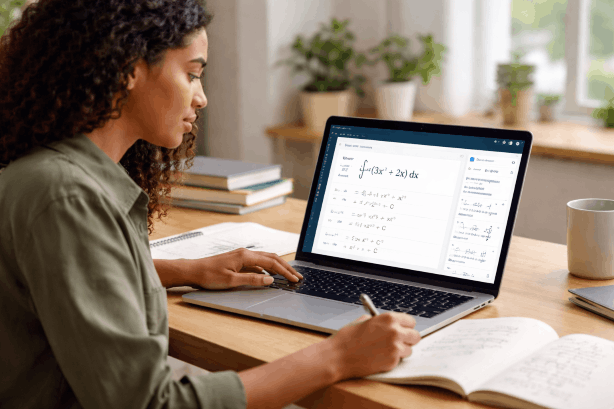
Every math student knows the cascade: one sign error in step two and the next forty minutes are spent producing a beautifully-reasoned wrong answer. Math is unforgiving that way — which is exactly why it's the subject where AI help is most useful and where unverified AI help is most dangerous. A tool that guesses confidently fails exactly like your sign error does: silently.
So instead of the usual "AI can solve anything!" tour, here is a capability map — what math solving AI genuinely handles in 2026, level by level, where it breaks, and what separates a tool you can trust from one you have to babysit. We build one of these tools, and this is the map we'd want as a user.
The capability map
| Level | Reliability | What to watch for |
|---|---|---|
| Arithmetic & pre-algebra | Effectively solved | Only input misreads |
| Algebra I & II | Excellent | Multi-step sign slips in unverified tools |
| Geometry & trigonometry | Strong | Diagram interpretation quality varies |
| Calculus I–III | Strong | Technique choice on integrals; limits at edge cases |
| Linear algebra, stats, ODEs | Strong on standard coursework | Notation parsing (matrices, subscripts) |
| Proofs & abstract math | Weakest area | Fluent-but-invalid arguments; can't be auto-verified |
The pattern behind the table: reliability tracks verifiability. Where an answer can be checked mechanically, modern tools are excellent. Where it can't, treat output as a draft.
Level by level
Arithmetic through algebra
Linear equations, systems, quadratics, factoring, rational and exponential equations — this is the structured heart of school math, and it's where AI solutions are strongest. The failure mode isn't reasoning anymore; it's reading. Which brings its own section below.
Geometry and trigonometry
Geometry stressed early math AI because problems live in diagrams, not text. Vision-model input changed that: a screenshot carries the figure, its labels, and the givens together, so the tool works from the same picture you do. Identities, triangle solving, circle theorems, and coordinate geometry are all routine now. Quality still varies between tools on unlabeled diagram relationships — if the problem depends on noticing two angles are vertical, check that the solution actually cites it. (For a worked tour of the most-taught theorem of them all, see our Pythagorean theorem guide.)
Calculus
Derivatives are essentially mechanical for AI — the rules are finite and composable. Integrals are more interesting because they require strategy: substitution or parts? partial fractions first? A good tool doesn't just land the answer; it names the technique and shows why it applies, which is what you'll be graded on. Scrny covers Calculus I through III (multivariable, vector calculus) and states the rule at every step — chain rule, integration by parts, by name.
Past calculus
Linear algebra, statistics, and ordinary differential equations are covered well on standard coursework, and select graduate topics beyond them. Statistics deserves a special mention because it's the level most non-math majors actually need: descriptive statistics, probability rules, distributions, confidence intervals, and hypothesis testing are all standard, verifiable territory — and the shown work matters double here, because stats questions are graded on the setup (which test? which tail? which n?) as much as the arithmetic.
The practical limiter this far up isn't the math — it's notation density. Matrices, subscripted sequences, and piecewise definitions demand a clean capture; more on that below.
Word problems — a level of their own
Word problems sit slightly outside the ladder because the hard part isn't the computation, it's the translation: extracting quantities and relationships from prose and setting up the right equations. Modern math AI does this well, and the setup is precisely what you should read most carefully in the output — if the tool's equations match how you'd have modeled the situation, the rest is mechanical; if they don't, one of you has misread the problem, and finding out which is the whole educational value.
Proofs — the honest weak spot
Proof-writing is the one row of the map where you should stay skeptical. Structured proofs with a known shape (geometry two-columns, induction) come out fine. Novel proofs are where AI fluency outruns AI rigor: the output reads like a proof, cites plausible-sounding lemmas, and can still be invalid — the infamous hallucinated theorem. Because there's no mechanical check for "is this argument sound," verification can't save you here. Use AI proofs as scaffolding to interrogate, never as something to hand in unread.
Where math AI goes wrong
Three failure modes account for nearly everything:
- Input misreads. A 7 read as a 1 in cramped handwriting, an exponent read as a coefficient, a minus sign lost at a line break. The tool then solves the wrong problem perfectly — the most misleading failure there is.
- Multi-step slips. Long derivations give an unverified model many chances to drop a sign or mangle an algebraic simplification mid-stream, exactly like a tired human.
- Hallucinated facts. Rare in computation, real in proofs and theory: an invented identity or misremembered theorem stated with full confidence.
How two-way verification catches them
This is the design decision we consider non-negotiable. Before Scrny shows you an answer, it checks it twice, from two directions:
- Symbolically — the result is manipulated back against the original expression. Differentiate the antiderivative; expand the factorisation; the forms must reconcile.
- Numerically — concrete values are substituted into both the original problem and the answer. If x = 3 balances the original equation, the algebra survived the whole derivation.
Two-way verification converts failure modes 2 and 3 from silent errors into caught errors. It can't fix mode 1 — no check survives solving the wrong problem — which is why the remaining craft is on your side of the screenshot:
- Capture the whole problem: all givens, the diagram, the actual question sentence.
- Don't crop mid-expression; a lost term is an input misread you created.
- Handwriting works, but ambiguous digits are on you — when in doubt, rewrite the line.
- If a part references "your answer from (a)," include part (a) in the frame.
Using the map well
Match the tool to the row you're on. For K-12 photo math, Photomath is genuinely excellent and we say so in our comparison; Scrny's case begins where step attribution, verification, and post-K-12 coverage start to matter. And on any row: read the steps, not the last line. The step where an AI solution surprises you is either where you had a gap (good — that's learning) or where the tool slipped (good — you caught it). If you'd rather be walked to the answer than handed it, Learn Mode runs the same engine in guided mode — and our AI math homework helper guide covers the day-to-day workflow.
The honest summary: in 2026, math solving AI is a reliable colleague from arithmetic through the calculus sequence and standard university coursework, a useful but checkable assistant above that, and a fluent liar often enough in novel proofs that you should keep your skepticism switched on there. Used with that map in mind, it's the most effective math study tool that has ever existed.