

Most chemistry homework isn't hard because chemistry is mysterious. It's hard because five specific problem types carry ninety percent of the workload, and each one has a standard method your textbook explains once, in chapter order, months before you actually need it on a mixed problem set.
This is a playbook for those five. Each section shows a genuinely worked example — the reasoning, not just the answer — plus the single most common way students get that problem type wrong. Keep it open next to your problem set.
1. Stoichiometry: grams → moles → moles → grams
Every mass-to-mass problem is the same three-step bridge. You can't convert grams of one substance directly into grams of another; you have to cross through moles.
Worked example. How many grams of water form when 8.0 g of hydrogen gas burns completely in excess oxygen?
The balanced equation: 2H₂ + O₂ → 2H₂O
- Grams → moles (of what you have). Hydrogen gas is H₂, molar mass 2.016 g/mol: 8.0 g ÷ 2.016 g/mol = 3.97 mol H₂
- Mole ratio (the bridge). From the coefficients, 2 mol H₂ produces 2 mol H₂O — a 1:1 ratio: 3.97 mol H₂ → 3.97 mol H₂O
- Moles → grams (of what you want). Water's molar mass is 18.02 g/mol: 3.97 mol × 18.02 g/mol = 71.5 g H₂O ≈ 72 g (two significant figures, matching the 8.0 g given)
The classic mistake: skipping step 2 entirely — converting grams of H₂ to moles and multiplying straight by water's molar mass. It feels right because the numbers flow, but it silently assumes every ratio is 1:1. The ratio here happens to be 1:1; on the next problem it won't be. Write the ratio down every time, even when it's trivial.
Screenshotting it: a solver like Scrny's math mode returns this chain with each conversion labelled, which makes it useful for checking where your attempt went wrong rather than just whether it did.
2. Balancing equations: coefficients, never subscripts
Balancing is bookkeeping: the same count of each atom must appear on both sides, and the only thing you're allowed to change is the big number in front of each formula.
Worked example. Balance the combustion of propane: C₃H₈ + O₂ → CO₂ + H₂O
Balance elements that appear in only one compound per side first, and save the lone element (O₂) for last:
- Carbon: 3 C on the left → coefficient 3 on CO₂.
- Hydrogen: 8 H on the left → coefficient 4 on H₂O (4 × 2 = 8).
- Oxygen last: the right side now has (3 × 2) + (4 × 1) = 10 O atoms, so the left needs 5 O₂.
Result: C₃H₈ + 5O₂ → 3CO₂ + 4H₂O. Final count — C: 3/3, H: 8/8, O: 10/10. Balanced.
The classic mistake: changing a subscript to force the count — turning H₂O into H₂O₂ because you needed more oxygen. That doesn't balance the equation; it changes water into hydrogen peroxide and describes a different reaction entirely. Subscripts are the substance's identity. Coefficients are the only dial you get.
3. Gas laws: the Kelvin conversion is the whole problem
Gas law questions are usually one line of algebra. The marks are lost before the algebra starts, in the unit conversions — temperature above all.
Worked example. A balloon holds 2.50 L at 25 °C and 1.00 atm. What is its volume at 50 °C, same pressure?
Pressure is constant, so this is Charles's law: V₁/T₁ = V₂/T₂ — with T in kelvin.
- Convert: T₁ = 25 + 273 = 298 K; T₂ = 50 + 273 = 323 K.
- Solve: V₂ = V₁ × (T₂/T₁) = 2.50 L × (323/298) = 2.71 L
A modest expansion, which matches physical intuition — the absolute temperature only rose about 8%.
The classic mistake: leaving temperature in Celsius. 50/25 = 2, so the balloon "doubles" to 5.0 L — a wrong answer that looks confident. Celsius ratios are meaningless because 0 °C isn't zero thermal energy. If a gas-law answer implies a dramatic change from a mild temperature shift, recheck the kelvin conversion before anything else. The same discipline applies to the ideal gas law: match your units to R before substituting.
4. Molarity and dilutions: V₂ is the final volume
Concentration problems reduce to two tools: the definition M = mol/L, and the dilution relation M₁V₁ = M₂V₂.
Worked example. How would you prepare 250.0 mL of 0.100 M NaCl from a 2.00 M stock solution?
The moles of NaCl don't change when you add water — that's all M₁V₁ = M₂V₂ says.
- Solve for the stock volume: V₁ = (M₂ × V₂) / M₁ = (0.100 M × 250.0 mL) / 2.00 M = 12.5 mL
- Procedure: measure 12.5 mL of stock, transfer it to the flask, then add water up to the 250.0 mL mark.
The classic mistake: reading V₂ as "the water you add." It's the final total volume. Adding 250 mL of water to 12.5 mL of stock gives 262.5 mL of solution — a concentration about 5% off, which is exactly the kind of error that survives to the final answer looking plausible. Dilute to the target volume, not by it.
5. Electron configurations and periodic trends
These questions are pure pattern recognition, and the patterns are small enough to memorise properly.
Worked example. Write the electron configuration of Fe and of Fe³⁺.
Iron is element 26. Fill in energy order (4s before 3d):
- Fe: 1s² 2s² 2p⁶ 3s² 3p⁶ 4s² 3d⁶ — or [Ar] 4s² 3d⁶
For the cation, here's the twist: electrons are removed from the outermost shell first, which means 4s empties before 3d even though 4s filled first.
- Fe³⁺: remove both 4s electrons, then one 3d electron → [Ar] 3d⁵
That half-filled 3d⁵ subshell is notably stable, which is part of why Fe³⁺ is so common.
The classic mistake: pulling the three electrons off 3d because "3d was filled last." Fill order and removal order are different rules. If your transition-metal cation still has 4s electrons in it, it's wrong.
The trends, compressed: across a period, nuclear charge rises with no new shell, so atomic radius shrinks and first ionisation energy rises. Down a group, each row adds a shell, so radius grows and ionisation energy falls. Most trend questions are one of these two sentences wearing a costume.
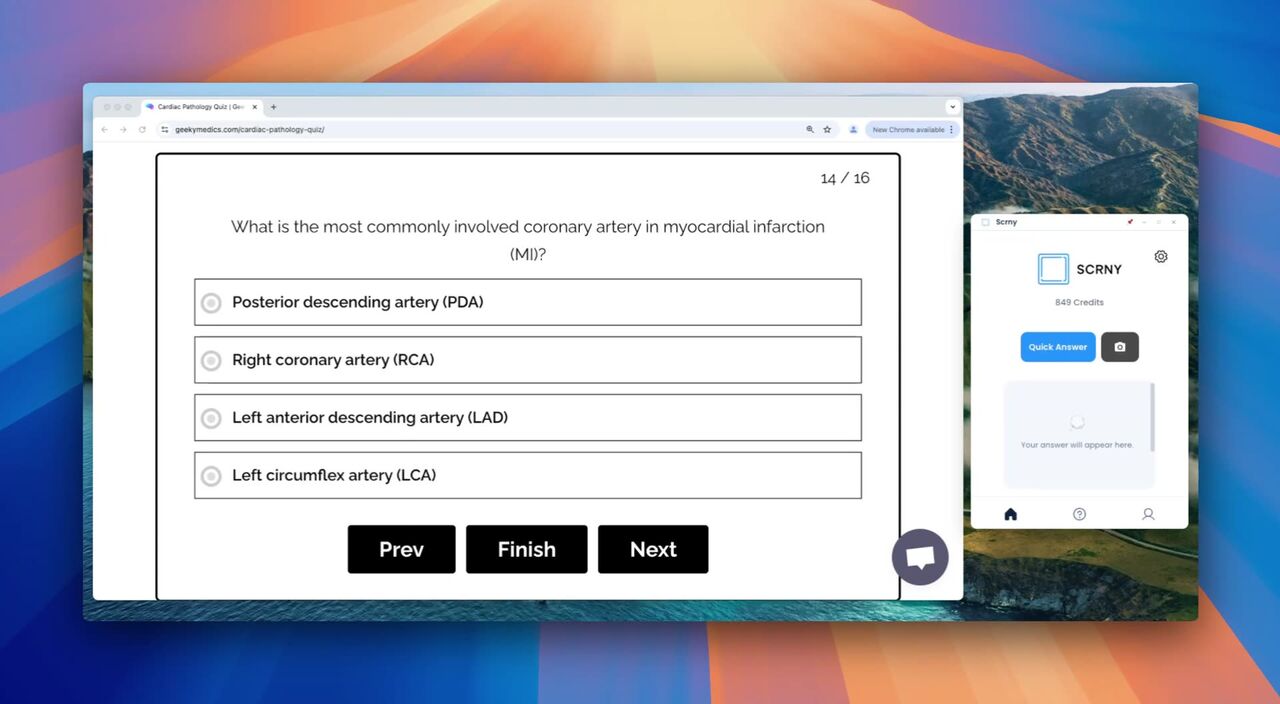
Matching the tool to the problem type
If you use an AI helper on this material, match the mode to the moment:
- Checking your working on stoichiometry, gas laws, or dilutions — a screenshot into Math Solver returns the step chain in about 2.4 seconds, so compare it against your own steps line by line.
- Multiple-choice chemistry — periodic trends and electron configurations show up constantly as MCQs; Multiple Choice mode explains the reasoning for every option, not just the right letter.
- Actually learning it — Learn Mode refuses to hand over the answer and instead asks one guiding question at a time ("what are you given, and in what units?"), with the answer behind a button when you want it. For cumulative subjects like chemistry, this is the mode that pays off at exam time.
One honest boundary: an answer engine is for practice and understanding. If the assignment is graded work you're meant to do alone, the worked examples above are the help — the tool's job is to get you to where you can do the next one unaided.
Where this fits in the bigger picture
The five playbooks above cover the calculation core of a general chemistry course. For the study-strategy layer — how to pick tools, when AI help is genuinely useful versus a crutch — see the wider guide to the best AI homework helpers, and if your sticking point is math rather than chemistry, the AI math homework helper guide goes deeper on multi-step solutions.
Chemistry rewards exactly one habit above all: writing the method down even when you can see the answer. The problem types repeat. Learn the five bridges, flag the five mistakes, and the problem set stops being a wall.