
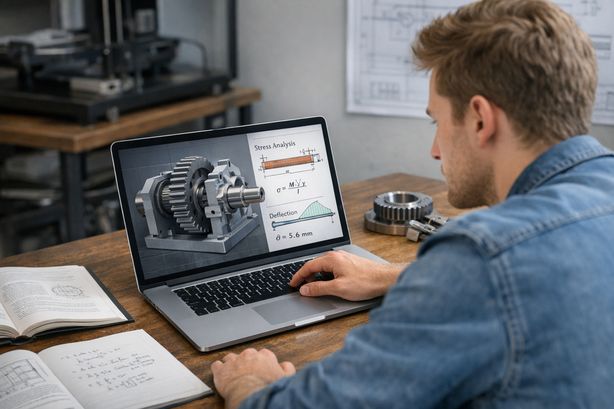
Mechanical engineering is one of the most rewarding — and most demanding — fields of study in higher education. From statics and dynamics to thermodynamics and fluid mechanics, the coursework piles on fast, and a single problem set can consume an entire evening. If you’ve ever stared at a free-body diagram at 1 a.m. wondering where the third reaction force went, you’re far from alone.
The need for reliable mechanical engineering homework help has never been greater. Engineering programs are competitive, deadlines are relentless, and the material builds on itself in ways that make falling behind genuinely dangerous for your GPA. Office hours are limited, tutors are expensive, and study groups don’t always align with your schedule.
That’s where modern AI-powered tools come in. Scrny is a desktop and mobile application that lets you screenshot any homework question — including complex diagrams, equations, and multi-part engineering problems — and receive detailed, step-by-step explanations in seconds. Instead of waiting for a tutor or scouring forums for a similar example, you can get targeted help exactly when you need it, right at your desk.
What Makes Mechanical Engineering Homework So Challenging?
Mechanical engineering sits at the intersection of physics, mathematics, and applied design. Unlike subjects where you can often memorize formulas and plug in numbers, most ME problems require you to synthesize multiple concepts, interpret physical scenarios, and make assumptions before you even begin solving.
Here are some of the core reasons students seek mechanical engineering homework help:
- Multi-step problem solving: A single statics problem might require you to draw a free-body diagram, resolve forces into components, apply equilibrium equations, and then verify your solution — each step introducing opportunities for error.
- Visualization challenges: Concepts like stress distributions, moment diagrams, and 3D force systems are inherently spatial, and many students struggle to translate between a physical setup and the mathematical model.
- Interconnected subject areas: A thermodynamics problem might require fluid mechanics intuition and calculus-level integration, meaning gaps in one area cascade into others.
- Dense notation and conventions: Engineering textbooks use specialized symbols, sign conventions, and unit systems that can be confusing even for strong students.
- Time pressure: Engineering programs are notorious for assigning heavy problem sets on tight deadlines, making it difficult to give every problem the attention it deserves.
These challenges don’t mean you aren’t cut out for engineering — they mean the subject genuinely requires more support infrastructure than many other disciplines. The right kind of help with mechanical engineering homework isn’t a shortcut; it’s a necessity.
Core Mechanical Engineering Subjects Where Students Need the Most Help
Mechanical engineering curricula vary by university, but the subjects that consistently drive students to look for homework help tend to fall into a few key categories.
Statics and Dynamics
Statics is typically one of the first engineering courses students encounter, and it sets the foundation for everything that follows. Problems involve analyzing structures, trusses, beams, and frames in equilibrium. Dynamics extends these concepts to objects in motion, introducing kinematics and kinetics.
Common pain points include:
- Drawing accurate free-body diagrams
- Solving systems of equilibrium equations
- Understanding friction and distributed loads
- Applying Newton’s second law to rigid body systems
- Tackling relative motion and rotating reference frames
Thermodynamics and Heat Transfer
Thermodynamics asks students to think about energy, entropy, and the laws governing physical systems — often in abstract and counterintuitive ways. Heat transfer adds conduction, convection, and radiation analysis on top of that foundation.
Students frequently struggle with:
- Identifying appropriate system boundaries
- Applying the first and second laws of thermodynamics correctly
- Working with property tables and phase diagrams
- Solving heat exchanger and fin problems
- Understanding entropy generation and irreversibility
Fluid Mechanics
Fluid mechanics combines vector calculus, conservation laws, and physical intuition in a way that challenges even mathematically strong students. Homework problems often involve pipe flow, boundary layers, dimensional analysis, and the Navier-Stokes equations.
Mechanics of Materials (Strength of Materials)
This course focuses on how solid objects deform under various loads. Problems involve calculating stress, strain, deflection, and failure criteria for beams, shafts, pressure vessels, and composite structures. Mohr’s circle, beam deflection methods, and column buckling are perennial sources of confusion.
Machine Design and Dynamics of Machinery
Upper-division courses like machine design require students to apply material from statics, dynamics, and mechanics of materials to real-world component selection and analysis — gears, bearings, shafts, fasteners, and fatigue life calculations.
How AI-Powered Tools Are Changing Mechanical Engineering Homework Help
Traditional options for getting help with mechanical engineering homework include office hours, tutoring centers, study groups, and online forums. Each has its place, but each also has significant limitations:
AI-powered homework help tools like Scrny occupy a unique position because they combine instant availability with personalized, problem-specific explanations. You don’t need to retype a complex equation or try to describe a diagram in words — you simply screenshot the problem, and the AI interprets both the text and the visual elements.
This is particularly valuable for mechanical engineering, where problems almost always include diagrams, tables, or specialized notation that are difficult to communicate through text alone.
How Scrny Works for Engineering Problems
- Screenshot your homework question: Whether it’s a textbook problem, a PDF from your professor, or a handwritten problem set, Scrny’s screenshot tool captures it instantly.
- AI analyzes the problem: The AI interprets the image — including diagrams, equations, units, and any given data — and identifies what the problem is asking.
- Receive a detailed solution: Scrny provides a structured, step-by-step explanation that walks you through the reasoning, not just the final answer.
What sets Scrny apart from generic AI chatbots is its purpose-built screenshot functionality. Engineering homework rarely exists as plain text. It’s annotated diagrams, circuit-like thermal resistance networks, Mohr’s circles, and beam loading diagrams. Scrny is designed to handle exactly this kind of visual input.
Two Modes of Learning: Answers When You Need Them, Understanding When It Matters
One of the most thoughtful aspects of Scrny’s design is the dual-mode system that adapts to how you want to learn.
Answer Mode
Sometimes you need to verify your work or check a final answer before submitting an assignment. Answer Mode provides direct, complete solutions with all intermediate steps shown. This is especially useful when you’ve already attempted a problem and want to see where your approach diverged from the correct one.
For example, if you’ve calculated the deflection of a cantilever beam and gotten an answer that doesn’t match your intuition, Answer Mode will show you the full derivation — boundary conditions, integration steps, and final result — so you can pinpoint your mistake.
Learn Mode
For deeper understanding, Learn Mode uses a Socratic approach, guiding you through the problem with targeted questions and hints rather than handing you the answer outright. This is invaluable for conceptual courses like thermodynamics, where understanding why a process is irreversible matters as much as calculating the entropy change.
Learn Mode might prompt you with questions like:
- “What type of support is at point A, and how many reaction forces does it provide?”
- “Which thermodynamic property remains constant in this process?”
- “Have you considered the moment about point B to eliminate one unknown?”
This guided approach builds the problem-solving instincts that separate students who memorize procedures from students who truly understand engineering principles.
Why Mechanical Engineering Students Choose Scrny in 2026
The landscape of academic support tools has evolved considerably, and students today have more options than ever. Here’s why Scrny continues to stand out as a mechanical engineering problem solver:
- Visual input capability: Engineering is a visual discipline. Scrny’s screenshot-based input means you can submit problems exactly as they appear — diagrams, tables, notation, and all — without losing critical information in translation.
- Desktop and mobile integration: Scrny runs natively on Windows and macOS as well as mobile devices, so it fits seamlessly into your existing homework workflow. No browser tabs to manage, no web apps that time out.
- Subject breadth: Beyond mechanical engineering, Scrny handles math, physics, chemistry, coding, and more. Since ME coursework regularly draws from all of these, having a single tool that covers the full range is enormously convenient.
- Step-by-step explanations: Scrny doesn’t just spit out a number. It walks you through the methodology, which is exactly what you need when studying for exams — not just completing homework.
- Privacy and focus: As a desktop application, Scrny keeps your academic work on your machine. There’s no uploading to a public forum, no waiting for a stranger’s response, and no distractions.
Tips for Getting the Most Out of Mechanical Engineering Homework Help
Whether you’re using Scrny, working with a tutor, or studying independently, these best practices will help you maximize the value of any homework help resource:
1. Attempt the Problem First
Even a partial attempt gives you context. When you then review a solution — whether from Scrny’s Answer Mode or another source — you’ll immediately see where your reasoning went wrong. Passive reading of solutions is far less effective than active comparison.
2. Focus on the Method, Not the Answer
Engineering exams rarely repeat homework problems verbatim. What they test is whether you can apply the same methods to new scenarios. When reviewing step-by-step solutions, pay attention to why each step is taken, not just what is calculated.
3. Use Learn Mode for Conceptual Weak Spots
If you find yourself consistently struggling with a particular topic — say, entropy calculations or moment distribution — switch to Learn Mode and work through several problems with guided hints. This builds the mental framework that makes future problems feel more intuitive.
4. Keep a Problem-Solving Journal
After using Scrny to understand a difficult problem, jot down the key insight or technique in a dedicated notebook. Over the semester, this becomes a personalized reference that’s far more useful than rereading textbook examples.
5. Verify Units and Sign Conventions
A huge percentage of engineering errors come down to unit mismatches or sign convention inconsistencies. Before submitting any homework, double-check that your units are consistent (SI vs. Imperial) and that your sign conventions match the problem setup.
6. Connect Homework to Real-World Applications
Mechanical engineering is ultimately about designing things that work in the real world. When a problem asks you to calculate the factor of safety for a bolt, think about what that means physically — it’s not just an abstract number, it’s the margin between a functioning machine and a catastrophic failure.
Frequently Asked Questions
Can AI actually help with mechanical engineering homework problems that include diagrams?
Yes. Scrny is specifically designed to interpret screenshot inputs, which means it can analyze problems that include free-body diagrams, beam loading configurations, Mohr’s circles, thermodynamic cycles, and other visual elements that are standard in mechanical engineering coursework. You simply screenshot the problem as it appears, and the AI processes both the text and the image.
Is using an AI homework helper considered cheating for engineering courses?
Using AI tools for learning and understanding is generally no different from using a textbook solution manual, a tutoring center, or office hours — it’s about how you use the tool. Scrny’s Learn Mode is specifically designed to guide you through problems rather than simply handing you answers, which supports genuine learning. That said, always follow your university’s academic integrity policies and use any homework help tool responsibly.
What mechanical engineering subjects does Scrny cover?
Scrny covers a broad range of subjects relevant to mechanical engineering, including statics, dynamics, thermodynamics, fluid mechanics, mechanics of materials, heat transfer, engineering mathematics (calculus, differential equations, linear algebra), and physics. Because it works from screenshots, it can handle the specialized notation and diagrams common across all of these courses.
How is Scrny different from just asking ChatGPT or another general AI chatbot?
Scrny is purpose-built for homework help, with screenshot-based input that captures diagrams and equations as images — something general chatbots handle poorly. It also offers a dedicated Learn Mode for Socratic-style guided learning and provides structured, step-by-step solutions rather than conversational prose. For visual, technical subjects like mechanical engineering, this makes a significant practical difference.
Mechanical engineering homework is demanding by design — it’s preparing you to solve problems that matter in the real world, from designing safer vehicles to building more efficient power systems. But demanding doesn’t have to mean overwhelming. With the right support tools, you can work through even the most complex problem sets with confidence and genuine understanding.
Scrny gives you that support exactly when you need it: instant, detailed, and tailored to the specific problem in front of you. Whether you’re wrestling with a truss analysis at midnight or trying to build deeper intuition about the second law of thermodynamics, Scrny is the mechanical engineering homework help that meets you where you are. Screenshot your next tough problem and experience the difference for yourself.
Turn a Screenshot Into an AI Answer in 3 Seconds.
Snip an image and let our AI answer generator do the rest.
Save time: no copy-pasting questions.
Stay accurate: 99 % accuracy using the latest AI answer generator technology
Monthly Subscription. Cancel anytime.
Recommended Articles

[
AI Homework Helper: Screenshot Any Question, Get Instant Answers
](https://scrny.ai/)
By Scrny.ai

[
How to Use Screenshot Homework Help: Snap a Photo, Get Step-by-Step Solutions
](https://scrny.ai/blog/screenshot-homework-help)
By Scrny.ai

[
Best AI Homework Helper 2026: Top Tools Compared
](https://scrny.ai/blog/best-ai-homework-helper)
By Scrny.ai